
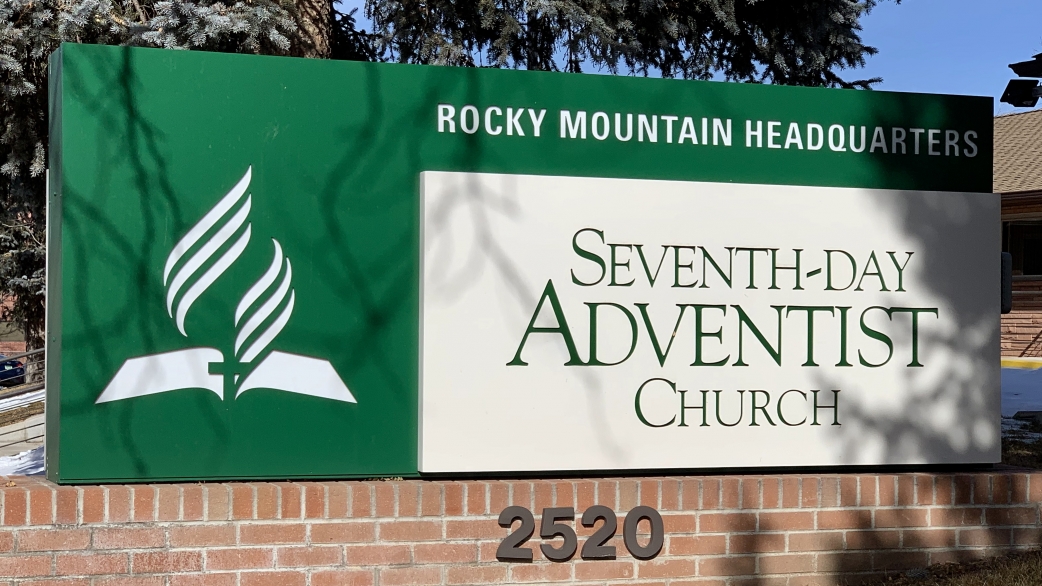
Welcome to the Rocky Mountain Conference
The Rocky Mountain Conference (RMC) serves a vibrant community of Seventh-day Adventists across Colorado, Wyoming, and San Juan County, New Mexico. The administrative headquarters for this region is located in Denver, Colorado, and it supports almost 17,000 members, 60 pastors, 130 churches, 15 schools, two camp and retreat centers, and several hospitals and medical centers. Together, these ministries create opportunities for people of all ages to grow in faith, build community, serve others, and share the hope of Jesus.
The Rocky Mountain Conference is part of the Mid-America Union, one of nine unions within the North American Division of the Seventh-day Adventist Church. We are also part of a global family of more than 23 million Seventh-day Adventist Christians, serving communities in nearly every country around the world.
Brief History of RMC
The first known Seventh-day Adventist in Colorado was a young girl who traveled across the plains from Kansas in a covered wagon during the Pike’s Peak Gold Rush of the 1860s. After finding work in Denver, she married a miner named Shaw, and the couple eventually made their home in Golden.
An important pioneer was Cora M. Thayer, later Cora M. Jones, who settled in Georgetown with her two young daughters, Bertha and Myrtle. The three were described as “lights in the darkness” among the scattered mining communities, helping kindle the Adventist message in the region.
Another early Adventist was Mrs. Amy Dart, who had been part of the group of believers who anticipated the Second Coming of Jesus during the 1844 Movement. While living near Baraboo, Wisconsin, she accepted the Sabbath as the biblical day of worship. In 1872, she settled in Boulder, where she became well known for her missionary activities.
That same year, James and Ellen White established a summer retreat in Colorado. During their time in the state, they held what became the first formal series of Seventh-day Adventist meetings in Colorado. Their presence, combined with the work of other early believers, helped establish a foundation for the growing Adventist movement in the region.
The movement continued to grow. Established congregations emerged in Boulder during the 1870s, followed by Longmont in 1880 and Denver around the same time and there was work of an unnamed Adventist man in Montrose. Through the distribution of Adventist literature, camp meetings, evangelistic efforts, and numerous small Bible-study groups, the message continued to reach communities throughout Colorado.
Boulder became an especially important center of Adventist activity. On August 2, 1879, the first Seventh-day Adventist congregation in Colorado was formally organized there with 40 charter members. James and Ellen White were present for the inauguration of the congregation. From these early efforts, Adventist churches were eventually established in Denver, Colorado Springs, Longmont, Fort Collins, and communities across the Western Slope.
Colorado also became an important location for the development of Adventist healthcare ministry. The Boulder Sanitarium became the second Seventh-day Adventist healthcare institution in the United States, following the Battle Creek Sanitarium and Hospital under the direction of John Harvey Kellogg.
Several Adventist pioneers, including Ellen G. and James White, who at the time was president of the General Conference, visited Boulder while seeking to regain their health. Their presence and ministry contributed to the evangelistic work in the community and helped lay the foundation for the Boulder Sanitarium.
By 1882, just over a decade after the arrival of some of the earliest known Adventist believers, the movement had grown sufficiently to be organized as the Colorado Conference. The growth was fueled by a dynamic commitment to sharing the gospel and an emphasis on biblical truth.
For the next century, Adventist ministry throughout the region continued to expand. In 1981, the Colorado Conference merged with the Wyoming Conference to form the Rocky Mountain Conference.
Today, the Rocky Mountain Conference is the largest conference in the Mid-America Union. Its ministry extends across Colorado, Wyoming, and San Juan County, New Mexico, and encompasses a diverse network of churches, schools, ministries, and community outreach efforts.
The region also has a significant Seventh-day Adventist healthcare presence through AdventHealth in the greater Denver area. This includes AdventHealth Porter, AdventHealth Littleton, AdventHealth Parker, AdventHealth Castle Rock, and AdventHealth Avista, along with supporting emergency clinics and medical offices.