24 Jun

CENTURA-LITTLETON ADVENTIST HOSPITAL ASSOCIATES MARK JUNETEENTH IN HEALING GARDEN

Littleton, Colorado … Friday on Juneteenth, the oldest nationally celebrated commemoration of the end of slavery in the US, a group of our leaders and associates at Centura-Littleton Adventist Hospital gathered to reflect on the meaning of the day amid these difficult times.

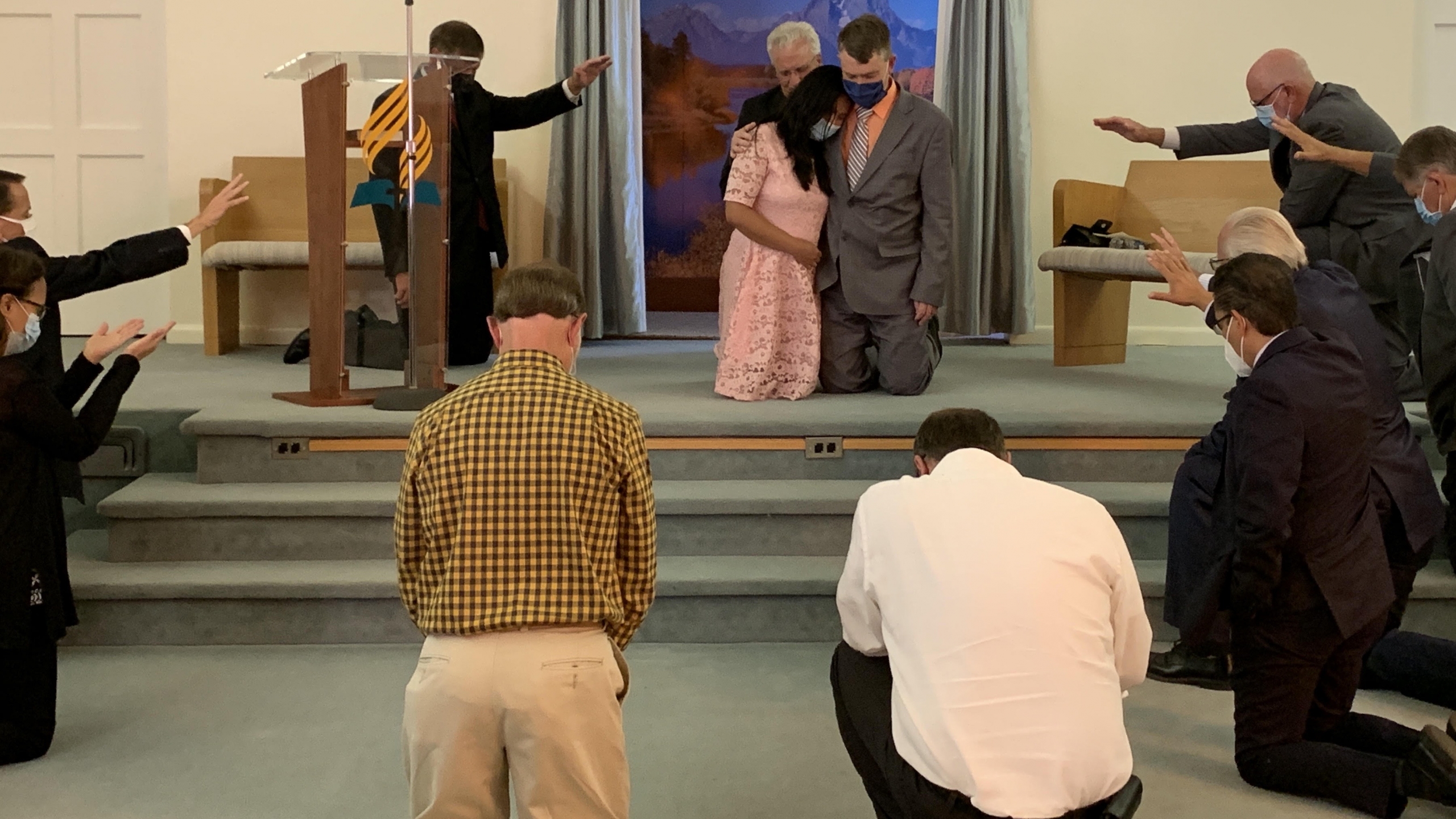
They kneeled for 8 minutes and 46 seconds in memory of George Floyd and the many others whose lives have been impacted for too long by racial injustice.

“We don’t want this just to be a thing that we did once and doesn’t go any further,” said Lead Chaplain Dany Hernandez. “The hope is that this gathering will lead to life-changing conversations and dialogue. This is about humanity, love, respect, and unity.”

“Some people might not be very comfortable with what we are doing today because everybody attaches it to something else,” Dany said. “This is not about law enforcement, this is not about politics, this is about a group of people that for too long have experienced racism in a way that a lot of us will never be able to relate to.”

Centura has stated that our healing ministry, rooted in a commitment to the sanctity of life, is on a mission to positively change the world, and this includes advocating against racial inequity and injustice.

Added Dany: “We’re going to stand up for racial equality and against racism and stand up for every marginalized community.”

He also thanked the administrators and physicians who supported Friday’s event.

–Courtesy of Littleton E-Update Newsletter.

23 Jun

Commentary – Gavrilo Princip did not start World War I

By Joel Reyes — I keep hearing people, including journalists, refer to the riots that are literally consuming our country as the “George Floyd” riots. There are many things wrong with this term and its implications. We would almost have to assume that things were well in our country until looters poured out into the streets after the murder of George Floyd.

To credit the murder of George Floyd as the cause of the 2020 riots is like assuming that Gavrilo Princip started World War I. History books tell us that on June 28, 1914, Princip assassinated Archduke Franz Ferdinand, heir to the Austro-Hungarian throne, and his wife Sophia, as they drove through the streets of Sarajevo, Bosnia. Princip was a member of a Serbian secret nationalist society known as the Black Hand, who sought to stop Austro-Hungarian influence in the Balkan region. Austria-Hungary blamed Serbia for the murder and one month later, declared war on Serbia starting what we know today as World War I. Some still claim that if Princip had not assassinated Ferdinand, perhaps Austria-Hungary would not have invaded Serbia and we would not have had World War I.

What is happening across our country today, is only a glimpse of a greater problem, a problem we as a country have been sweeping under the bed for centuries: tribalism. Our society is sick and has been sick for a very long time. What we are experiencing now did not start with a video showing graphic images of the murder of George Floyd. The illness is much older, and we have been carrying it for centuries. The disease is not terminal, but for so long we have refused to seek treatment or even acknowledge that we carry it.

I was born in Central America and I am one of those refugees who left my home country in my youth when that country boiled in civil war. Like many other Latin American countries, El Salvador had been ruled by military dictatorships for centuries. By law, citizens were made to vote. No, it was not a right to vote; it was a crime not to vote. Citizens went to the polls and voted against the dictators, but they knew quite well that their vote had no voice. They knew who their next president would be, and it would not be the one they were voting for. It would be the general in military regalia and shiny boots. People did the only thing they could: protest.

But the generals did not like that. It made them look bad, especially when foreign visitors were around. Many of these dictatorships were sponsored and advised by the CIA, and they could not afford to look weak, or they would lose the lucrative US funding they received. If the municipal police could not handle the situation and the protesters did not go home, the generals would send the tanks, and the streets would be cleared quickly. People tried to voice their discontent every way they could, but to no avail. On one occasion, a general by the name Maximiliano Hernandez Martinez, removed Indians from lands they had owned as an ancestral inheritance since before colonial times. The Indians had held and used their properties following ancestral customs of communal ownership, never registering them, as the Martinez government mandated. Martinez saw the Indians as lazy, ungovernable, and ignorant, and used “Land Reform” as an excuse to take their land away and “redistribute” it to large coffee planters. His actions provoked political unrest and massive demonstrations by the peasant population. The general declared martial law and sent the army into the streets. In the space of six days, tens of thousands of peasants were killed, imprisoned, or disappeared. The year was 1932.

There comes a time in the life experience of people when frustration overrides reason. We saw it during the 2016 election, which spawned “Never Hillary” and “Never Trump” movements. These were people who could not find much good in the candidate they were endorsing, yet they were willing to tolerate causes they really opposed to see the other candidate defeated. This happens when people are driven to the point of hopelessness. They have tried, they have waited, they have endured for generations, and seen no results. They grow so hopeless, they no longer care. This is also a time when people stop talking, and tribalism takes over. Tribalism is exclusive and self-serving. It blurs commonalities and magnifies difference. It fertilizes distrust, suspicion and hate, and vilifies compassion, tolerance and cooperation. It instills a culture of “survivalism,” making it easier to throw rocks at those outside the tribe. People see no point in stepping over the aisle, going instead into their own corner for protection from perceived adversaries. And the only thing they want from there on is to see “them” defeated, or even killed. There is no need to talk. There is no need to cooperate. There is no need to care about “them.”

Eventually, people in El Salvador stopped demonstrating peacefully, and began taking up arms. Such a move did not help them much, as the army had better weapons, and lots of money to spend. This frustrated people even further. It was then that the voices came, the agitators, the opportunists, the pied pipers and people listened. They heard words they had never heard before – insurrection of the masses, revolution, political oppression, proletariat, Marxism, and many others. People did not know what all those things meant, but they did not care. They embraced the promise of seeing the generals defeated, dead. “Nothing can be worse than what we have,” they would say. Had these people been given a chance for peace, they would have taken it. Had they been given a fair chance to dialogue, they would have taken it. Had their electoral choices been respected, they would not have listened to the other voices. But it was too late. Many like to measure the civil war in El Salvador as a twelve-year conflict that started in 1979 after the deposition of General Carlos Romero. Many would even argue that this was not more than a struggle against communism, as if everything had been fine and well until 1979. Just a month before the peasant revolt of 1932, US Major, A.R. Harris, had written a letter to the US War Department stating the following. “I imagine the situation in El Salvador today is very much like France was before its revolution, like Russia was before its revolution. The situation is ripe for communism, and the communists seem to have found that out.” (Report of military attaché A.R Harris, to the War Department, December 22, 1931)

I believe that most civil conflicts could be prevented if it wasn’t for pride and selfishness. We want to be right. We always want to win, and spit on the loser’s face. We see it as a virtue. We are strong, and nobody messes with us.

When we, as a society, choose to go into our own corner and close our ears to anything that comes from the other side, we have started building the foundation for civil war. War happens when people stop talking, and there are no winners in a civil war. The riots of 2020 are showing us how easily things can get out of hand and how we all lose when people stop caring. The cocktail has been brewing for a long time, ready to explode, ready for a little spark. The murder of George Floyd provided that spark. No, the problem is not our politicians, or even the police. The problem lies deeper within each one of us. Until we realize the value of others and are willing to break away from our tribe and walk over the aisle and make the sincere effort to understand and respect the position and opinion of those we disagree with, things will only get worse. The pressure inside the keg will only continue to grow. Politicians are only a reflection of who we are. We elect them, and we elect them according to our values. They fight worse than cats and dogs, but isn’t that what we want them to do? In the process, they inspire us with anger, frustration, and hate. We don’t want them to compromise. There is no room for moderate voices. We call that weakness. We don’t want them to listen to the opinions of the other tribe. We praise them when they are mean and vicious toward the people we hate. We want them to be like us. Don’t blame them. They are us.

No, the death of George Floyd was no more the cause of the riots than was the murder of Archduke Ferdinand the cause of World War I, or the coup of General Romero the cause of the Salvadorian Civil War. It was the fruit of years of frustration, hopelessness, and eventually self-exile into tribalism. As Christians, we need to pause and measure our words and actions by the words of Jesus, not the behavior of political leaders. It’s not about being right. Self-righteousness leaves no room for dialogue. What we need the most today is Christians who can muster all the courage needed to look weak. We cannot continue measuring others by our own reality. We need to be willing to recognize and empathize with the struggles of others and be willing to listen and validate their reality. We need to stop telling people to “grow up and forget about it.” Let’s step out of our tribal strongholds and see those we don’t like as human beings, as fellow sojourners in this land, as citizens worthy of our respect. We also need to be humble and admit that we have gotten this whole thing wrong. There will be no solutions if we continue to do things the way we have been doing them. The solution is up to us.

–Joel Reyes is principal of Intermountain Adventist Academy in Grand Junction, Colorado; (pictured are Archduke Franz Ferdinand and wife in Sarajevo June 28, 1914) Photo by Creative Commons.

22 Jun

FIRE DAMAGES COLORADO’S BRIGHTON CHURCH

By Jon Roberts — Brighton, Colorado . . . Within minutes of its outset, the Brighton Fire Rescue District responded to a fire at the Brighton church which engulfed its social annex shortly after 8:00 p.m. on Sunday, June 21.

Firefighters were on the scene within six minutes of the initial call.   When they arrived, the exterior of the annex side of the church was engulfed in flames and fire had spread to the attic. The initial responding crew placed a call for assistance from three additional units within Brighton Fire Rescue District, and two units from South Adams County Fire Department.

After a forced entry through a door in the back of the building, firefighters were able to gain access to the attic space. They extinguished the flames before the fire had a chance to spread to other areas of the building.

Immediately after putting out the fire, fire crews gave clearance for church personnel to enter the church and they began to clean up and assess the damages.

“This is quite extensive. The annex at this point is not useable,” said Rodney Kelly, head elder. “The food bank has been totally affected. We are not able to hold food bank this week as we were planning to,” he finished.

“This affects our community that were hoping to having appropriate resources coming into the holiday week, Kelly explained.  “This is a big concern [that], we are not able to provide what we had planned for our community.”

Working throughout the night, Kelly contacted an electrician in an attempt to save the refrigerators and freezers in the food bank. Electricians were able to run new circuits overnight to restore power to those vital components of the food bank. The rest of the building remains without power.

Fire investigators are conducting a full investigation, with initial findings revealing that the fire appeared “to have started as an outside fire in bushes and trees. It extended into the soffit and attic space. Crews were able to stop the fire in the attic and limit any further damage,” according to a Facebook update posted on Sunday evening by the Brighton Fire Rescue District.

Insurance has been notified and the conference is working closely to ensure that paperwork is submitted to Adventist Risk Management. The extent of the damage to the exterior and attic is yet to be determined.  No injuries occurred, and the building was empty at the time of the fire.

The church welcomes assistance as it plans to reopen a community food pantry and refurbish its facility, says Kelly. “We could use any help anyone wants to provide,” he adds “if you are able to assist, please contact the Brighton church via email at [email protected].”

“I’m glad nobody was hurt. There are material damages, [but] material things can be repaired and replaced,” Kelly concluded.

–Jon Roberts with additional reporting by Rajmund Dabrowski.  Photos by Rajmund Dabrowski and Brighton Fire Rescue District Facebook.

22 Jun

Adventist Church in North America Issues Response to Fringe Group Newspaper Ad Mentioning Church

Columbia, Maryland . . .On June 21, 2020, the Seventh-day Adventist Church’s North American Division issued the following statement after a full-page advertisement was published by a fringe organization on the same day in the Nashville Tennessean, a Gannett-owned newspaper.

“The Seventh-day Adventist Church in North America is deeply disturbed by the two hurtful ads recently published in the Nashville Tennessean.

“The claims made against the Muslim community have caused pain and strife. We soundly reject these hateful and dishonest words. Further, we need to be clear: there is no connection between the Seventh-day Adventist Church and this group and their teachings, which serve to hurt and cause disharmony.

“One of the Adventist Church’s Fundamental Beliefs states, ‘In Christ we are a new creation; distinctions of race, culture, learning, and nationality, and differences between high and low, rich and poor, male and female, must not be divisive among us. We are all equal in Christ, who by one Spirit has bonded us into one fellowship with Him and with one another; we are to serve and be served without partiality or reservation’ (Fundamental Belief 14, Unity in the Body of Christ).

“The Seventh-day Adventist Church requests that the Nashville Tennessean repudiate the advertising and publicly state there is no connection between the Adventist Church and this group.”

Not only does the ad briefly mention the Seventh-day Adventist Church, the group used quotes from Ellen G. White, one of the Adventist Church’s founding members, out of context. “The Ellen G. White Estate rejects any interpretation of Ellen White’s writings that suggests she predicts a specific target of impending disaster, the timing of any such event, or a connection to the Muslim, or any other, faith group,” said Jim Nix, director of the Ellen G. White Estate, an entity of the Seventh-day Adventist Church world headquarters.

–This article was originally published on the NAD Website.

22 Jun

FROM MONO-ETHNIC TO MULTI-ETHNIC: ONE CHURCH’S JOURNEY

By Mike Maldonado — Colorado Springs, Colorado … It has been said that a church should reflect the demographic of the community it is in. If a community is mainly Caucasian, then it is no fault of the church if its members are mostly Caucasian. But if a church is in a racially diverse community and the demographic is mainly Caucasian then there is work to be done. That is the situation we (my wife and I) found ourselves in eleven years ago when we first arrived in Colorado Springs to pastor Central church. Colorado Springs is a diverse community due to the large military presence, numerous universities and colleges, a booming economy, and a red-hot housing market.

Yet for the most part, Central church was mostly Caucasian with little diversity. I do not believe Central’s “whiteness” (for lack of a better word) was due to prejudice or overt racism, but rather from a lack of diversity-oriented leadership in the past. The bottom line is the leader of an organization or church creates the culture and values of the organization. When my wife and I arrived in Colorado Springs, we were welcomed with open arms, mainly because they had been without a pastor for almost a year! I do not think they realized the implications of having a pastor born in Mexico and a pastor’s wife born in Nicaragua who is also one-quarter Chinese!

One of the core values my wife and I have is that racial diversity is a beautiful thing. It does not matter what area you are talking about, having a mix of cultures and ethnicities always makes life more fun and beautiful. We got these values from having lived overseas for a period of time, traveling extensively around the world, and my wife’s two dozen medical mission trips to places such as Kenya, Uganda, South Sudan, Venezuela, Columbia, Greece, Iraq and many more.

When we arrived at Central, the standard practice when a person of a different racial background showed up, was to let them know (out of courtesy, of course) that there was a Black church, Korean church, Hispanic church that they might like trying out. We even had directions to the other churches printed out for such an eventuality. I immediately stopped this practice. We made sure that the greeters did not send people of color to other churches but let them know they were welcome at Central. Up front, I verbalized again and again that all people were welcome at Central regardless of race or ethnicity. But it was not just about race, we also let people know that anyone, no matter what their background or history, was welcome. Our vision for the first nine years was simply to create a safe place for all people to come and grow spiritually together. It took time, but word eventually got out that Central had changed!

Two other big steps in transitioning from an all-white church to one more reflective of the community was International Sabbath and Brenda’s mission reports. Once a year we host an International Sabbath where we have a guest speaker from another country, where the service is done in various foreign languages and we encourage members to come dressed in their national dress. It is now our most popular service, mainly because of the international lunch after the service! In addition, every time Brenda went on a mission trip, she always came back with an inspiring mission report/sermon. She has awakened the congregation to the beautiful diversity in the world and brought it back to Central church.

We were also very intentional about bringing diversity into our leadership team. Eleven years later, it is remarkable to experience the diversity at Central. The senior pastor is Mexican, the head elder is Caucasian, the associate pastor is Samoan, the secretary is from British Virgin Islands, our Bible worker is Jamaican, and our school board chair is African-American. In response to George Floyd’s death, I preached a three-part series on “Jesus and Human Rights”.

On Sabbath, June 27, the church will sponsor an evening of discussion and prayer on growing up black in America. There are still a few pockets of resistance in the church, but with love, education, strong leadership and the softening of the Holy Spirit, walls of prejudice and fear are coming down and the banner of Christ is being raised high above the nations.

Mike Maldonado is senior pastor of Colorado Springs Central Church. Photo by Rajmund Dabrowski

22 Jun

SHORT ARMS AND DULL EARS – COMMENTARY

By Doug Inglish . . . I have always had trouble finding the proper fit in long sleeved shirts, owing to arms that are unusually long relative to my stature. But an odd benefit of this configuration has been the ability to check the height of ceilings. Standard residential height is eight feet, and while rarely called on to use this specific skill, all I ever had to do to check that measurement was reach up. If my fingertips barely grazed the ceiling, it was eight feet exactly.

Until fairly recently, anyway. A warning to those who are unaware–you start getting shorter sooner than you think. I can’t do it anymore; my fingertips fall short. Oh well.

As long as I am on the topic of my diminishing skill set, not only are the things I was good at fading, the things I was not good at are getting worse. (Life after 40 is full of these discoveries, and I passed that quite some time ago.) My hearing loss was confirmed while I was still in college, and the progression of this malady requires me to pick up my new and improved hearing aids next week.

Many of you can relate to what you are reading, and the rest of you inevitably will someday. But The Ageless One is not similarly afflicted: “Surely the arm of the Lord is not too short to save, nor His ear too dull to hear” (Isaiah 59:1, NIV).

I may not be able to touch the ceiling anymore, but the God that we serve can reach us anywhere! I may need to ask you to repeat something, but God hears the whisper of every prayer! That’s cause for rejoicing, but it is also a reminder to believe He is able and ask Him to address our needs.

A story to illustrate this point:

The stewardship director of a Conference several years ago noticed, during an economic downturn, that there was a strong possibility the annual tithe would not match the previous year. His concern for the continued mission of the church led him to spend the last half of the year earnestly praying that they could at least hold steady on tithe and not suffer a loss. His prayer was answered when the Conference achieved a gain of 0.1 percent.

Instead of rejoicing, he felt shame. He realized that knowing God has excellent hearing is of limited value if you underestimate the length of His arms. What if instead of asking to avoid a shortfall, he had asked for a substantial gain? His prayers in subsequent years reflected a greater appreciation for God’s limitless reach.

We are currently running more than three percent behind in tithe for the year. The mission of the church will be affected if this loss continues. This is not a drill. This is a time for faithfulness, and a time for prayer.

As you remember the tithe situation in your prayers, remember the experience of the stewardship director in our story, a now retired gentleman whom I appropriately refer to as ‘Dad’. The arm of the Lord is not short, nor is His ear dull, so ask big.

Doug Inglish is RMC planned giving and trust services director. Photo by Marc-Olivier Jodoin on Unsplash

21 Jun

The Seventh-day Adventist Pioneers and Their Protest Against Systemic Racism

By Kevin M. Burton . . .The second advent movement was inseparable from the abolitionist call for the immediate and total destruction of slavery and demand for equal rights for the oppressed. From the rise of the Millerite movement in the early 1830s through the end of the Civil War, adventists of all varieties used the tactic of moral suasion to warn pro-slavery Americans that God would soon return and judge them if they did not immediately repent and reform. In this manner, they made protest against racial injustice inseparable from their adventist faith. Though many adventists avoided association with political parties because they supported slavery, beginning in 1840 a significant number joined the Liberty Party, which had a single platform: the immediate and total abolition of slavery and “the restoration of equality of rights among men.”[1] In 1848, the Liberty Party nominated Gerrit Smith—a prominent abolitionist, Millerite adventist, and seventh-day Sabbath observer—as candidate for president of the United States. Throughout the entire antebellum period, Millerites and Seventh-day Adventists also risked their lives to liberate slaves from bondage. While some did this legally by purchasing slaves’ freedom, many broke federal law by assisting fugitives on the Underground Railroad. They upheld God’s fugitive slave law in Deuteronomy 23:15, 16: “Thou shalt not deliver unto his master the servant which is escaped from his master unto thee. He shall dwell with thee, even among you, in that place which he shall choose in one of thy gates, where it liketh him best: thou shalt not oppress him” (KJV). Indeed, in all of these ways and more, adventists were inspired by their Christian faith to fight against systemic racism in America.

The anti-slavery cause was rooted in black protest, and black Seventh-day Adventists were also active abolitionists. John “the Dominie” W. West, a Seventh-day Adventist minister, a former slave and close friend of Gerrit Smith, preached against the evils of slavery and racism, published and promoted several of Smith’s abolitionist works, and operated a store in Peterboro, New York, that sold no products grown by slave labor. In Bath, New York, Elias and Henrietta Platt were local Adventist leaders and the most active abolitionists in their town. Elias served as the local agent for Frederick Douglass’ The North Star and operated a free-produce store like West. The Platts regularly hosted traveling abolitionists. In January 1852, the Platts hosted James and Ellen White in their home during a time when virtually all white northerners refused to publicly associate with blacks. When Elias Platt died unexpectantly in 1854, Frederick Douglass wrote his obituary, stating that Platt was “one of the most devoted, honest, and persevering friends of his people in the State of New York.”[2]

Seventh-day Adventists also petitioned against southern slavery and northern racism. Joseph and Prudence Bates were leading abolitionists in Fairhaven, Massachusetts during the the 1830s and 40s. They signed and circulated petitions to abolish slavery and prevent the annexation of new slave states, urged the United States to recognize Haiti’s independence, and helped abolish racial segregation on trains and the law against interracial marriage in Massachusetts.[3] In the 1850s and 60s, Adventists petitioned against more issues, like the death penalty (believing that both slavery and capital punishment “represented systems of brutality that coerced individuals”[4]), the 1850 Fugitive Slave Act, and the Kansas-Nebraska Act (1854). In the 1860s, Seventh-day Adventists sometimes placed the denomination’s name on petitions they wrote and circulated. In April 1862, for example, a group of forty-four “Seventh Day Adventists and others” from Linn County, Iowa, testified, “That our professions of Christianity and boasts of liberty, are but a mockery in the sight of the nations of the Earth and of the God of the Universe, so long as we delay practically to recognize the ‘Inalienable right of all men to life, liberty, and the pursuit of happiness.’ ” The Linn County Adventists then “urged” Abraham Lincoln and Congress to immediately abolish “the great unnatural crime of slavery, the exhaustless inveterate source of our national ruin.”[5]

Seventh-day Adventists also incorporated abolitionist arguments into the Three Angels’ Messages (Rev. 14:6–12). The first angel warned that the hour of God’s judgment was at hand and Adventists emphasized that if pro-slavery Americans remained unrepentant, they would be doubly punished for their sins. The second angel warned that Babylon was fallen, and Millerites came out of the Protestant churches (Babylon) because they supported slavery. Ellen White specified that any Seventh-day Adventist holding pro-slavery sympathies must be immediately disfellowshipped. Finally, Seventh-day Adventists connected the third angel’s message against worshipping the beast with anti-slavery. Revelation 13:1–18 reveals that the two-horned beast enforces idolatry, and Adventists identified America as this beast because it professed to uphold religious and civil liberty (the two horns), but in reality denied those privileges to religious and racial minorities.[6]

The Seventh-day Adventist pioneers fought against oppression through their faith and actions during an era when only a tiny minority of Americans protested against racism. By incorporating anti-slavery arguments into the Three Angels’ Messages, Seventh-day Adventists made protest against systemic racism an important part of their fundamental beliefs and challenged their spiritual descendants to carry on this faith.

Kevin M. Burton, Ph.D. Candidate (Florida State University), teaches in the History and Political Studies Department at Southern Adventist University and is writing his doctoral dissertation on Millerite and Seventh-day Adventist involvement in the abolition movement.  Photo supplied.

[1] Thomas Hudson McKee, National Conventions and Platforms of All Political Parties, 1789 to 1905: Conventions, Popular, and Electoral Vote, 6th ed.(Baltimore, MD: Friedenwald Company, 1906), 52.

[2] Kevin M. Burton, “Born a Slave, Died a Freeman: John ‘the Dominie’ West, Seventh-day Adventist Minister and Abolitionist,” Adventist Review 196, no. 4 (April 2019): 52–55; “List of Agents,” The North Star, April 17, 1851, p. 1, col. 1; “Free Labor Sugar & Molasses,” Steuben Courier, December 31, 1845, p. 3, col. 2; Carter G. Woodson, ed., The Mind of the Negro as Reflected in Letters Written during the Crisis, 1800-1860 (Washington, D.C.: Association for the Study of Negro Life and History, 1926), 353; [James White], “Our Tour West,” The Advent Review, and Sabbath Herald, February 17, 1852, 93; Richard Archer, Jim Crow North: The Struggle for Equal Rights in Antebellum New England (New York: Oxford University Press, 2017); Beth A. Salerno, Sister Societies: Women’s Antislavery Organizations in Antebellum America (Dekalb, IL: Northern Illinois University Press, 2005), 32–33; [Frederick Douglass], “Died,” Frederick Douglass’ Paper, July 7, 1854, p. 3, col. 6.

[3] Kevin M. Burton, “Joseph Bates and Adventism’s Radical Roots,” Adventist Review, March 3, 2020, accessed May 6, 2020, https://www.adventistreview.org/joseph-bates-and-adventisms-radical-roots.

[4] Louis P. Masur, Rites of Execution: Capital Punishment and the Transformation of American Culture, 1776–1865 (New York: Oxford University Press, 1989), 157.

[5] Petition of Seventh-day Adventists and Others of Linn County, Iowa, for the Abolition of Slavery in the United States, April 1862, SEN 37A-J4, National Archives, Washington, D.C.

[6] Ellen G. White, 1T, 259, 358; Charles Fitch, “Come Out of Her, My People”: A Sermon (Rochester, NY: J. V. Himes, 1843), 16; Ellen G. White, 1T, 360; Douglas Morgan, Adventism and the American Republic: The Public Involvement of a Major Apocalyptic Movement (Knoxville, TN: University of Tennessee Press, 2001), 15–29.

This article was originally published on the NAD Ministerial Website.

18 Jun

A Conversation on Racism and Adventism with NAD Leadership

Columbia, Maryland . . .Daniel R. Jackson, president of the North American Division, G. Alexander Bryant, NAD executive secretary, and Randy Robinson, NAD treasurer, sat down with Mylon Medley, assistant director of NAD communication, to discuss recent events related to racial injustice, the history and relevancy of regional conferences, and the presence of racism in the denomination’s past and present. WATCH the conversation from the NAD website; or go directly to the video on Vimeo.

Resources for Conversations on Racial Justice and Equality

Here are some suggested resources for local churches and members as they have discussions on racial justice and equality. More resources may be added to this list as they become available. The majority of these resources have been compiled by Carmelo Mercado, vice president and Multicultural Ministries department director of the Lake Union Conference, and Dave Gemmell, associate director of the North American Division Ministerial Association.

CLICK HERE  for this comprehensive list. 

Courtesy of NewPoints June 18, 2020

18 Jun

THE WISEST OF THE WISE

By Don Marsh–As we enter the summer months, we are getting outside, enjoying the flora and fauna of our Rocky Mountains. After being quarantined for months, to be able to enjoy God’s creation in person is a such a blessing. I love one quaint passage in Proverbs that praises some of God’s small creatures.

Four things there are which are smallest on earth yet wise beyond the wisest:
ants, a folk with no strength, yet they prepare their store of food in the summer
rock-badgers, a feeble folk, yet they make their home among the rocks
locusts, which have no king, yet they all sally forth in formation;
the lizard, which can be grasped in the hand, yet is found in the palaces of kings.
— Proverbs 30:24-28 REB

There are more than 20,000 species of ants in the world, with dozens in Colorado. They build intricate colonies, with different rooms for different functions. They seem to be always moving, working together in an amazing division of labor. Some species store up food for the winter or fatten up so they won’t need to eat during the cold months.

In our area, the pika is most similar to the biblical badgers (called “conies” in the King James Version).  Pikas are small relatives of rabbits that live at or above timberline, protected from the elements and predators by building dens in the talus, or loose rock. They seldom venture far from their secure homes.

It is reported that in 1875 a swarm of Rocky Mountain locusts (now extinct) streamed overhead for five days, blotting out the sun. Composed of 10 billion individuals, the swarm devoured as much vegetation as a massive herd of bison. Experts at the time estimated that the swarm was 1,800 miles long and at least 110 miles wide, large enough to cover Wyoming and Colorado.

There are several varieties of lizards in the geographical area of the Rocky Mountain Conference. The horned toad is even the state reptile of Wyoming. An impressive characteristic of lizards is their ability to camouflage themselves by changing body color and sometimes body patterns to blend with their background. Some species can walk on walls, and have no qualms about sneaking into people’s houses, whether king or pauper.

So, what is the lesson of these wisest of the wise? The ant knows that now is the time to prepare for the future. Conies know they are not strong by themselves but dwell securely in the place God prepared for them. Locusts know they must work together. One locust is harmless. Working together in a swarm, they are a mighty army. By ourselves, we can do little. Cooperating with God, we can do more than we could ask or think. Lizards seem out of place in a palace. We may think we don’t belong either, but Jesus promised he has a room for you in his house.

–Don Marsh, is chaplain at Good Samaritan Medical Center, Lafayette, Colorado.

16 Jun

outreach helps refugees

By Bob Reynolds – Aurora, Colorado . . . Two Denver area churches joined together to support an Aurora refugee neighborhood, with not only basic needs but also fellowship.

For the second year, True Life Community has partnered with Lakewood Fellowship to offer an outreach day to those who have fled their home countries with little or no belongings.

Heavenbound Outreach, meets every second Sabbath in a parking lot between two apartment complexes designed for refugees.  They offer clothing, household items, and toys for the children.  The outreach also allows for interactions with children offering popcorn, cotton candy, fruit drinks, and bottled water.

It is through area church donations, shopping yard sales, and browsing online sites for deals the items are gathered for distribution.  Heavenbound Outreach are always looking for donations of clothing and household items for the refuges. “We can pick up items or they can be brought to me,” Celestino Archaleta, volunteer with Heavenbound stated.

Archaleta started the outreach ten years ago, when he delivered items to a family in the complex and witnessed the need in the community.  The community is thankful to have this outreach available to them.

“This program is a shining example of how we as Christians can be of service to others in need,” stated the True Life Community pastor.  “These people need so much and we have so much we can give.  Each time we go, we see people carrying away boxes and bags full of shoes and clothes to their apartment.  Many of them have small children and we are so glad to see them get clothes, shoes and warm coats at winter time.”

Bob Reynolds, is pastor of True Life Community in Littleton, Colorado; photo supplied

1 192 193 194 195 196 256