05 Jan

THE LOST BLACK SHEEP

By Cryston Josiah — What man of you, having a hundred sheep, if he loses one of them, does not leave the ninety-nine in the wilderness, and go after the one which is lost until he finds it? And when he has found it, he lays it on his shoulders, rejoicing. —Luke 15:4,5

As we continue to simultaneously experience the realities of a deadly pandemic and racial tension, many have wondered about how we, as Christians, should relate to the group that Jesus, in Matthew 25, refers to as “the least of these.” That passage speaks for itself and clearly shows that as the King, the Son of Man separates the sheep from the goats. The separation is not based on knowledge of doctrine and intellectual understanding of theology, but on their response to those who needed help in a real and tangible way.

Many have debated the politics of the Black Lives Matter sentiment and have asked if we, as Seventh-day Adventist Christians, should be for or against it. I would humbly submit that the biblical passage which came to mind in helping us understand why this concept should be so important to Christians was the Scripture quoted above. Jesus, in this parable, gives us a glimpse of the compassion that God has for those who are spiritually lost. Yet, it also creates a window into His mind of how God persistently seeks to save the lost, not only spiritually, but physically as well. In this text, it is not that the 99 sheep did not matter to the Shepherd. However, they clearly were not the ones who were lost or in danger. I remember reading the old Uncle Arthur Bible Stories with the picture of the Shepherd clinging to the rocky cliff with one hand and the lost sheep with the other.

Regardless of our political or personal persuasion, the Christ-like character of God is always concerned for those who are “lost” and in danger. All American historians and sociologists have documented that, from the very birth of this nation, all men were indeed not treated as though they were created equal, as blacks were considered three-fifths of a man. Slavery, and subsequently the remnants of slavery, including Jim Crow laws, redlining, housing discrimination, mass incarceration, police brutality, financial discrimination, etc., have been the reality for the black sheep, the black and brown people in our nation.

The “black” sheep has not only been lost in America, but brought here not of its own will, and in real danger. Thus, there is a spiritual and moral responsibility for Christians to not only see the need to leave the ninety-nine who are safe and secure, and who still indeed matter to the Shepherd, but to search for, and care for and protect the one that is in danger, an endangered life.

It is such a blessing to know that our very own Seventh- day Adventist pioneers were strict abolitionists. Ellen G. White, Joseph Bates, and others wrote letters and articles condemning slavery and racism. They even sternly addressed Adventist churches and leaders, who endeavored to continue racist practices and traditions. In addition, they were supportive of joining and connecting with other groups, who were not members of our denomination on moral things that mattered.

Ellen G. White commented:
Light has been given me that there are those with most precious talents and capabilities in the Women’s Christian Temperance Union (WCTU). Much time and money have been absorbed among us in ways that bring no returns. Instead of this, some of our best talent should be set at work for the WCTU, not as evangelists, but as those who fully appreciate the good that has been done by this body. We should seek to gain the confidence of the workers in the WCTU by harmonizing with them, as far as possible. (Review and Herald, June 18, 1908) What a beautiful sentiment. As far as possible, Mrs.

White proposed that we should work for the good of humanity, even if we have disagreements on other points. Her sentiments appear to echo Jesus’ ministry statement of Luke 4:18, which was to preach the gospel to the poor, to heal the broken-hearted, to proclaim liberty to the captives and recovery of sight to the blind; to set at liberty those who are oppressed. Throughout the Gospels, Jesus repeatedly makes the appeal to the people and the religious leaders to recalibrate their minds about who is really our neighbor and what should be our primary focus as Christians.

In addition to Jesus’ mission statement written by Luke, in Matthew 25:31-46, Jesus highlights that those who have no concern for the least of these will suffer the same fate as Satan himself and his angels. In Matthew 25:41, Jesus declared, “. . . Away with you, you cursed ones, into the eternal fire prepared for the devil and his angels.” Ladies and gentlemen, why would our loving Lord make such a solemn declaration? He goes on to explain clearly that when you went on your merry way not caring for those who were hungry or thirsty or naked or incarcerated or sick, or when you didn’t even care why they were in those conditions and did nothing to alleviate their pain, anxiety, or suffering, it was Me that you were ignoring.

Even while those goats on the left are stunned and baffled, Jesus explained to them that He was the man who had a knee on his neck for 8 minutes and 46 seconds. He was the one wrongly accused, or was judged and executed without a trial, or was marginalized and oppressed, and you literally did and said nothing. The attitude toward the conditions of those described in this passage is literally what separates them from being sheep, the ones who hear, “Come ye blessed of my Father, inherit the kingdom prepared for you,” or being goats who are eternally lost. Jesus summarily acknowledged that the goats rejected the Word which says, “Open your mouth for the speechless, in the cause of all who are appointed to die. Open your mouth, judge righteously, and plead the cause of the poor and needy” (Proverbs 31:8,9).

In contrast, the attitude of the righteous toward those who are in need, toward those who are caged like animals, toward those who are unjustly beaten and murdered by those sworn to protect and serve them, toward the oppressed and the downtrodden, toward the marginalized, toward the hungry, thirsty, and naked, toward the stranger, that attitude of care, concern and compassion becomes the clincher for the King. That attitude of concern for those who can’t fend for themselves, those who can’t defend themselves, those who can’t pull themselves up by their own bootstraps because they never had boots—that attitude was the saving clincher for the Son of Man.

My prayer for us today is simply that we may see that one “Black” sheep and the least of these. And subsequently, that we will do all we can to demonstrate that they matter as much to us as they matter to God.

–Cryston Josiah is vice-president for administration, Central States Conference of Seventh-day Adventists. Email him at: [email protected]

05 Jan

IS SILENCE A SIN?

By Tony Hunter — Let’s start with a thought-provoking question: “Is silence a sin?” Answer: “Well, it depends . . .”

OK, that wasn’t very helpful. Great question, but a fairly unsatisfying answer. The problem is one of definition and context. Understanding what we mean when we use a word matters, and context is everything.

Question: “Tony, are you saying we can sort out both of those heavily-complex topics in less than 1500 words?”

Answer: “Um . . .” (pretends not to hear the question)

Let’s start with sin. What are we talking about when we use that word? That sounds like the correct question, but it isn’t. The correct question is: What were the original users of the word talking about when they used the word? In the New Testament, one of the main words translated as sin is hamartia (say “ha-mar-tea-uh”). It means “to miss the mark.” That seems like a reasonable definition. But here is a little contextual twist. It was a term that was used in ancient Greece for when archers missed their target.

On the surface, it’s a great metaphor. But let’s look deeper. When an archer is hitting a target, they don’t commit hamartia (sin). When they miss the target, they do commit hamartia (sin). Let me ask a question. What is the archer’s target? A paper bullseye? Or a man across a battle- field?

So, if an archer doesn’t kill someone with an arrow, he sins, but if he does kill someone with an arrow, he doesn’t sin. That seems to make the concept of sin more difficult. But you might point out that maybe I’m reading too much into the metaphor as most metaphors break down eventually.

Perhaps I am. But maybe not completely. Context is everything. There is a story in the Gospel of Luke (Luke 10:25-37 for those keeping score) where Jesus tells the story of a man beaten by robbers and left along the side of a road to die. Jesus is telling a parable, a metaphor, to answer the question that an expert in Jewish law asked Him regarding salvation that turned into a discussion about who our neighbor is. Because, to inherit eternal life, the expert of the law said, you must love the Lord your God with all your heart, soul, and strength, and love your neighbor as yourself.

Jesus liked the answer, but then the law expert asked another equally important question: Who is my neighbor? That’s when Jesus tells the story of the guy beaten and robbed. While this man is lying broken, bleeding, and dying along the side of the road, a priest walks by, sees the man, and then crosses the road to pass by as far away as he can, doing nothing to help. Then a Levite comes by and does the same, which was nothing.

It should be noted that priests served in the temple doing the most sacred and holy works, and Levites were the people that priests came from.

But then a third man, a Samaritan, came by, stopped and helped. Samaritans were looked down upon strongly by the people Jesus is speaking to. They were considered low class. They were seen as less than. But this man stopped, band- aged the man, took him to an inn, paid for his care, and saved his life.

After telling this story, Jesus asks who is the broken man’s neighbor? The expert rightly pointed out the Samaritan. Well, technically he didn’t because it seemed he couldn’t be bothered to acknowledge the Samaritan and simply said “The one who showed mercy.” And Jesus agreed.

Now, if we analyze this, I think most would agree that the Samaritan did well, and the priest and Levite missed the mark. They committed hamartia. They sinned.

Or did they?

The man is broken, bleeding, and dying. Most importantly, he’s bleeding. This is a problem for a priest and a Levite who were, as all Jewish and Israelite people were, for- bidden from touching things that are unclean. There is a whole list of unclean things, and blood is one of those things. Sure, they could do it, but there was a whole ritual and then a sequestering that would take place if they did. It was horribly inconvenient. So, the practice was—just don’t do it.

By not getting near that man, they were obeying the law. They were hitting the mark.

(Side note: What is lawful is not always just, and what is just is not always lawful. End of side note.)

But this article isn’t about what people do or don’t do. It’s about whether silence can be sin. It was bad enough that the priest and Levite didn’t choose mercy over law and act directly. But what is really more telling than what they did or didn’t do is what they didn’t say. They told no one. They didn’t get help. They didn’t find someone and tell them there was a man dying who needed help they weren’t able to provide.

They saw injustice and said nothing. It simply wasn’t convenient for them to do the right thing. From that perspective, they didn’t just miss the mark, they demonstrated they didn’t even know what the target was.

When we talk about sin, I’m curious if we know what the target even is? An equally important question is, as Adventist Christians, would you go somewhere Adventist Christianity says you shouldn’t to help a person Adventist Christianity says you shouldn’t be around because they are something Adventist Christianity doesn’t condone?

Would you get them help, or would you stay silent?

As a chaplain, I’m a mandated reporter. In fact, all pastors are technically mandated reporters. For those who don’t know, a mandated reporter is someone who is bound by law to report abuse. The abuse can come in the form of physical abuse or neglect. I’m oversimplifying this definition, so feel free to look it up for the full breadth of what that means. But the point is, if I see that someone is being abused or harmed or neglected, like children or the elderly, and I don’t report it, I can be charged by the law and be fined and/or imprisoned depending on how angry the judge is the day I’m dragged into court.

Our laws in this country tell us that if we see evil happening and say nothing, we are culpable for the evil taking place. Weirdly, the laws we use in Christianity do not usually include that caveat even though the Bible repeatedly makes the point that we are actually accountable for what we don’t do just as much as for what we do.

You might rightly agree that, obviously, if we see some- one being abused or murdered or some other horrible crime, we should be saying something. But what about the less obvious stuff? What about spiritual abuse? What about

theological abuse? What about when your pastor or elder or Sabbath School teacher stands before people putting down one group or another simply because they don’t believe the same?

When certain Adventists verbally attack Catholics and make declarations about people who believe that way, do we say, “Hey, it’s OK to not agree with them, but this is going way too far”? Do we stand up for pagans and atheists when some in our fold go on the verbal attack in Bible study? You don’t have to agree with a belief to defend the one who believes it. Are we not a people who stand for religious liberty? Or do we simply believe religious liberty only matters as it applies to Adventists?

The implication of the good Samaritan was that the Samaritan and the victim were of faiths that did not agree with each other. With that parable, Jesus implies a question. Are you willing to love everyone and stand for everyone and speak up for everyone, or only the ones like you?

Do we get so caught up in defending and distinguishing beliefs that we ignore the people on both sides? By equating the keeping of our beliefs with not sinning, do we wind up sinning by trying not to sin? By hitting one mark, do we miss another?

Are you willing to speak up for what is right, even if it makes the church look bad? Do we do what is right always, or only when it’s convenient?

The question was “Is silence a sin”? And the answer is, “Not always.” But sometimes it’s the greatest of sins. Maybe we don’t have the power on our own to stop evil and injustice. But we have a voice that is capable of exposing evil and bringing the help we can’t give.

It’s time to stop focusing on hitting marks (sin) and start focusing on showering our neighbor with all the love and mercy and justice that Christ is capable of funneling through us. Which brings us to one last question: Who is our neighbor?

Answer: Everyone.

–Tony Hunter is a Seventh-day Adventist pastor and a hospice chaplain working for Elevation Hospice in Northern Colorado. Tony and his wife, Nirma, live in Firestone, Colorado. Email him at: [email protected]

05 Jan

NO QUARANTINE FROM EQUALITY

By Jessyka and Kiefer Dooley — Jessyka and Kiefer Dooley in conversation about equality and the American Dream

Twenty-twenty has been a year for the books. We’ve all become accustomed to words like “unprecedented,” “can- celled,” “social distancing,” and “quarantine,” thanks to the COVID-19 pandemic. If that wasn’t enough, we were also caught up in a period of social unrest brought about by in- equities in our country that were highlighted by the highly publicized slayings of several people of minority ethnicities by police officers. So, while we were quarantining and social distancing in the midst of these unprecedented times, we turned on our televisions or opened up our Twitter apps to watch as social justice initiatives called out for the (re?) establishment of equality in America.

Jessyka: As followers of Jesus, we should be the first people to acknowledge that every single person is made in the image of God and loved by Him. But it’s one thing to acknowledge that and another to actually walk that out in our day-to-day lives. Jesus was one to not only root for the underdog, but to highlight them as loved and whole.

Over this past year I’ve seen many Christians go out of their way to proclaim how they are leaning on God during these troublesome times, then go out of their way to speak harshly against those they dislike, vote in ways that suppress the basic rights of their fellow citizens, and become more self- seeking rather than going out of their way to care for others.

Kiefer: I’m with you. I’d even go so far as to put our own titles in the mix . . . because I think that as Seventh-day Adventist Christian followers of Jesus, we do a very good job of acknowledging that every single person is equal in the eyes of God. But we may not be so good at putting it into practice. This could be in part because we’ve been set up to arrive at this point by the world around us. Our founding fathers, held in great regard by our country, made sure that equality was front and center in our nation’s charter documents. We all know the lines by heart. “We hold these truths to be self- evident, that all men are created equal, that they are endowed by their Creator with certain unalienable Rights, that among these are Life, Liberty and the Pursuit of Happiness.”

But like you said, Jess, somewhere along the line, we got mixed up and stopped way short of the call. We stopped with writing it down and never put it into practice. The ineptitude, the double standards, the “all men” actually meaning “land owning white guys” crept out of politics and into the way we live our lives as individuals…even now 244 years later. And it’s just counter to the way of Jesus Christ.

Jessyka: We have definitely stopped short of the call as a country, but as a church it seems like we lag even further behind. In the book of Galatians, Paul shares, “There is neither Jew nor Greek, there is neither slave nor free, there is neither male nor female, for you are all one in Christ Jesus.” If our church lived that out, I for one, would have had a better experience growing up as a female in the Seventh-day Adventist Church. I think, in a lot of ways, denominations across the board have become a mere reflection of their current culture and political climate rather than pursuing the way of Jesus first and foremost.

Kiefer: To take what you’ve said and elaborate . . . we can’t rely on the world, or America, or the constitution or even the institution of the Church to be our guide. If we do, we’ll always be disappointed. We’ll always see some flaw in the reflection. I feel like this is especially true of the call to justice and equality—both of which are very much biblical ideals. Before highlighting the flaws anywhere else, we must find ourselves fully known and loved and filled in a relationship with Jesus.

We need to see others equal because it’s what Jesus sees. Not because the Church or anyone else asks us, or doesn’t ask us, to see that way. It’s from our position as sons and daughters of Jesus that we can go about the politics (or activities associated with making decisions in groups) of equality inside of the church and inside of the country with His mindset. After all, what is the Church and what is the Country other than the people who make it up?

Jessyka: Exactly. I’ve often found myself easily pointing out the flaws I see in our country and in our church when it comes to the poor execution of equality, but at the end of the day, I’m a United States citizen and I’m a member of the Seventh-day Adventist Church. If I’m not actively living in the Spirit and following in the footsteps of Jesus, I’m just as much to blame.

The crazy part is what Jesus calls us to do is so radically different from the “American Dream” so many of us aspire to pursue. He does not call us to accumulate heaps of wealth, but rather to give to those who are in need. He doesn’t ask us to draw barriers both physically and metaphorically between ourselves and others, but rather to welcome them with open arms. He doesn’t call us to hatred and violence, but rather to turn the other cheek. Sometimes I feel like living a life modeled after Jesus is very “anti” American.

Kiefer: Jesus’ way is definitely not the American way. I think we can look to the Sermon on the Mount to see that Jesus takes everything we hold in high esteem and flips it up- side down. Blessed are the poor and the meek? The last shall be first? Excuse me, Jesus . . . don’t you mean blessed are the rich. The hustlers? The winners? No. He was pretty clear.

The way of Jesus is different and uncomfortable when held against our American worldview. But this is where we must take action to make decisions that demote the self and elevate the other. Because this is where we find equality and justice. We can make personal sacrifices for the good of our communities. We can see the tax collector, the prostitute, the thief, the stranger, the foreigner, the homeless, the “other,” and maybe even a woman, as equal. When the “other” is authentically viewed as an equal through the lens of Jesus, our actions will fall into place. When our actions fall into place, equity and justice will have a foothold to take root and transform our community, our church, our nation, and our world.

–Jessyka and Kiefer Dooley are RMC youth leaders. Email them at: [email protected] and [email protected]

05 Jan

A SIN OF RACIAL PREJUDICE

By Shawn Brace — Much to my chagrin, I don’t cry much. But this last summer I found myself sobbing after I decided to do what many other people around the world did in May: I pulled up YouTube on my phone and watched every second of an 8 minute and 46 second video. And I cried and cried and cried.

I cried as I watched a black man having his life literally asphyxiated out of him. No, he was not a sinless and perfect man. Who among us is? But George Floyd bore—a tragically past tense verb—the Imago Dei. He was a child of God just like all of us. And yet his life was taken from him in broad daylight by sinners who felt no remorse about casting stones.

As I re-watched the video a few times, another figure caught my eye and ear as well. A bystander on the sidewalk kept pleading with the police to stop murdering Floyd. At times, the bystander’s language turned entirely vulgar, utilizing four-letter words that the privileged are taught never to use.

And yet a strange thought came to me, perhaps too scandalous for the pious mind. I heard Jesus in that man’s voice, cuss-words and all. After all, if such a cold-blooded tragedy doesn’t raise the ire from the God who once cursed a figtree for not bearing fruit (see Mark 11:12-25), what does that say about this God who allegedly died for George Floyd?

The question is, does God have a church who will join Him and that man on the sidewalk, willing to shed traditional forms of polite piety for the sake of speaking up and advocating for the “least of these”?

Our History of Social Justice

It may come as a surprise to many, but Seventh-day Adventists used to be at the forefront of social activism, zealously fighting against slavery and the racism that justified it. Our early history is littered with pioneers who passionately argued that being an Adventist and being an abolitionist were not mutually exclusive. In fact, some perhaps would have said they were necessarily mutually inclusive.

Figures such as Joseph Bates, Uriah Smith, J. N. Andrews, and James White staunchly spoke out against slavery, expressing their views frequently in all the major church publications, including the Advent Review and Sabbath Herald. John Byington, who became the first president of the General Conference, participated in the Underground Railroad, even building small chapels to hide runaway slaves. In fact, Byington had left the Methodist Episcopal Church and joined the Adventist faith partly because the former was so soft on the slavery question while the latter wrote and spoke passionately about it.

Of course, perhaps none were more outspoken than the prophet herself. Ellen White was clear on the slavery question, maintaining that any person who had pro-slavery sympathies should not have fellowship with Adventists, and insisting that the Fugitive Slave Law, requiring northerners to return enslaved people who had escaped, was to be dis- obeyed. “We must abide the consequences of violating this law,” she wrote. “The slave is not the property of any man. God is his rightful master, and man has no right to take God’s workmanship into his hands, and claim him as his own.” What is so fascinating about the pioneers’ attitudes toward the slavery issue is that they apparently didn’t feel that speaking against it would undermine their evangelistic opportunity. They didn’t worry that it would distract from their gospel witness. In fact, they felt that to not speak against slavery would undermine their gospel and evangelistic credibility. This they did, even while understanding that being staunchly abolitionist would close evangelistic doors in the southern states. But it was the price they were willing to pay in order to maintain gospel integrity and consistency.

Indeed, they viewed abolition and anti-racism as a gospel work. They were intimately connected in their minds. They even thought it was “present truth,” identifying America as the “land beast” of Revelation 13 partly because of its practice of slavery.

Is It Still “Present Truth”?

As we look across the landscape of Adventism today, one wonders if we still think that the work of anti-racism is a gospel work that reflects “present truth.” Some argue, of course, that since slavery was abolished long ago, and that further still, since the Civil Rights act was passed in the 1960s, the work of anti-racism resulted in glorious victory for America long ago. Those battles have been fought and won, both within and without the church, and we must instead focus on issues that will unite us rather than divide us.

Some further argue that harping on questions of racism distracts from Adventism’s primary calling to proclaim the Three Angels’ Messages. Those who focus on social justice and equality are playing a political game, the thinking goes, manipulated as pawns by political actors. We are therefore to bury all such questions.

For many of our brothers and sisters of color, however, it is anything but a distraction and it is anything but a political question. It is a lived reality. It is their reality.

A few months ago, one of my black friends, who had organized the Black Lives Matter march in our city in the wake of George Floyd’s death, which I gratefully marched in, offered this poignant perspective on such an attitude. “As a Black child, man, father,” he wrote, “no media outlet, politician, or organization has tricked me into thinking any- one is racist. Every single opinion I have about racism has come from my own experiences in school, in my community, and in the workplace as a Black American. Saying people of color are being tricked is essentially saying we are too stupid to interpret facts.”

In 1 Corinthians 12, the apostle Paul, in explaining how the church of Christ is like a body, noted that “if one member suffers, all the members suffer with it” (1 Corinthians 12:26, NKJV). For those of us who are white, who were raised in a context in which our skin color and race were never used against us as a liability, we may have a hard time understanding how racism could still be a problem.

But we are all a part of the body. And we need to learn how to trust our brothers and sisters of color and feel their pain with them. When they say they are frightened when they get pulled over by the police, we should take their word for it rather than trying to explain their anxiety away. When they say that the words we speak come across as insensitive and uncaring, we should honor their vulnerability and authenticity. No one ever changes their views by having someone invalidate them anyway. We bring healing to the suffering in our midst by suffering with them, not by telling them they have no reason to feel like they’re suffering. And we bring healing by speaking out, like that bystander on the sidewalk, against the ways in which our brothers and sisters of color are still being marginalized and excluded.

A few months ago, I got an unexpected message on Facebook from a young black man I didn’t know. He had attended one of our Adventist universities but struggled because of the climate of racism that he constantly felt on campus. A mutual friend of ours had sent him a number of posts I had written on Facebook in the weeks before that highlighted the important need for Christians to pursue the work of anti-racism.

Many of the posts had raised the ire of some of my white friends on Facebook, but connected deeply with my friends of color. When this young man reached out to me, he indicated that my posts had caused him to weep. He had never heard a white man, much less a white Adventist pastor, speak so powerfully to his experience. He had been tempted to give up on the Adventist church, but my posts had given him hope.

I don’t say this to imply any sort of moral superiority. I am far from perfect and have a lot to learn. But there are many people of color who are still wondering if they belong in our church. They wonder if it is safe for them.

We must learn to suffer with those who suffer, weep with those who weep, and curse with those who curse.

–Shawn Brace pastors in Maine and, along with his wife Camille and three children, is seeking to learn how to live out the gospel in his neighborhood and city. In 2018, he replanted his church to align more fully with God’s missional vision, focusing on the gospel, community, and discipleship. You can track his journey via his podcast, “Mission Lab,” [https://missionlab. podbean.com/] and his forthcoming book on the topic. Email him at: [email protected]

05 Jan

THE CULTURE PROXY WAR

By Shayne Mason Vincent — Because I am an independent, I appreciate truth on both sides of the aisle. Both major parties have something important to offer society; and they also both have extremes. A perfect example of this is my education. My schools of discipline include both social work and theology. I love them both for their deep insights into human nature. Yet both have very different solutions when it comes to “how to fix the world.”

Certainly, our society is in desperate need of “fixing.” But, whenever we attempt to discuss the issues of race, immigration, poverty, environment, governance, and taxation, the discussion becomes about party rather than principle. Worldview and political views are now assumed to be one and the same. Yet, it is entirely possible to be a Democrat who believes in fiscal responsibility, just as it is possible to be a Republican who cares about the poor.

Philosophy

Unfortunately, partisan media and politics have used current events to embroil our nation in a very dangerous, “cultural proxy war.” For at its core, they are in a philosophical battle for control of the narrative; and this war has been in the crock pot since the American and French Revolutions:

Two distinct lines of Enlightenment thought: first, the moderate variety following Descartes, Locke, and Christian Wolff, which sought accommodation between reform and the traditional systems of power and faith; and second, the radical enlightenment inspired by the philosophy of Spinoza, advocating democracy, individual liberty, freedom of expression, and eradication of religious authority. The moderate variety tended to be deistic, whereas the radical tendency separated the basis of morality entirely from theology. Both lines of thought were eventually opposed by a conservative Counter-Enlightenment, which sought a return to faith (Wikipedia).

As a nation, we are now likely near the end stage of this ideological war between enlightenment-based, secular-humanist values and historic constitutional Christian values where Secularism derives truth from the rationalistic and material; it values naturalism, evolution, secularism, rationalism, the sexual revolution, and post-modernism’s rejection of absolutes. Christianity derives truth from the metaphysical and biblical; it values church and state (theocracy), tradition, patriarchy, theism, and fundamentalism.

These two views have been in an open existential battle in our society for more than 200 years now. And as a firm believer that historicist-eschatology only applies to major paradigm shifts in history, I suspect that our culture war has prophetic significance related to Daniel 11:40 and Revelation 11:7; Egypt (secularism), the King of the South, and Babylon (Christianity), the King of the North, are battling for supremacy of worldview.

And here is where we must be wise. Fleeing Babylon does not mean we should run to the arms of Egypt simply because they support causes we cherish. To state this biblically, fleeing the earth and sea beast does not mean we should flee to the beast from the bottomless pit! We are followers of Jesus, not of this world; and sadly, we often seem to have a little too much of Peter and his sword in us.

Culture

So, when politicians, with all their double standards of moral equivalence, hijack legitimate issues for political expedience, citizens become enemies. We put up our dukes and stand our ground (no matter the side). I can’t tell you how many people I used to love in Christ who are now no longer on speaking terms because of politics. But in all of this partisan propaganda, Christians seem to have forgotten that the principles of Truth and Justice actually belong, not to the state, but to God!

Where do you think our modern “secular” ideals of justice came from? Rights for workers, women, children, blacks, immigrants, LGBTQ, and our social services, social security, adult and child protective services, and the five-day work week? They were originally championed by Christians! It began with what was called non-sectarian philanthropy. It was an ecumenical mission done by those who had a burden for the oppressed. This same work took place in Europe as well, under, for example, the Elizabethan Poor Laws, which were developed through the work of William Booth and his Salvation Army, as well as the abolitionist work of Christians for multiple centuries.

Their grand achievements for widows, orphans, the elderly, the working class, the slave, and the poor were slow and gradual, ultimately becoming institutionalized into secular law and government. But it was never done as an entitlement or a “right”; they fought for these causes because they loved Jesus and cared about their neighbor! And now, in all of our partisan madness, we seem to have forgotten that Jesus loved His enemies.

Scripture

So, let’s stop pigeon-holing God into one particular vein of conservatism or liberalism. He is a living God, and He expresses truth in a rainbow’s palette of colors. Consider the panoply of flowers, animals, clouds, and climates He has created. The refractions of light, the various colors, the end- less varieties. Clearly then, God loves all races, He loves all nations, and He loves the earth itself, for He created it all!

Therefore, as followers of Christ, what we should be looking for is, “What is truth?” What are the biblical principles I can support in these current events that are not related to the politics of it all? Because His Word is loaded with hundreds of texts that span both sides of the aisle:

James 1:27: Pure and undefiled religion before God and the Father is this: to visit orphans and widows in their trouble, and to keep oneself unspotted from the world.
Isaiah 58:6: Is not this the kind of fasting I have chosen: to loose the chains of injustice and untie the cords of the yoke, to set the oppressed free and break every yoke.
Leviticus 19:33-34: When a foreigner resides among you in your land, do not mistreat them. The foreigner residing among you must be treated as your native- born. Love them as yourself.
Revelation 11:18: He will destroy those who destroy the earth.
2 Thessalonians 3:10: For even when we were with you, we commanded you this: If anyone will not work, neither shall he eat.
2 Corinthians 9:6: But this I say: He who sows sparingly will also reap sparingly, and he who sows bountifully will also reap bountifully.
Proverbs 10:4: Idle hands make one poor, but diligent hands bring riches.
Proverbs 21:25: A slacker’s craving will kill him because his hands refuse to work.

The Church

The church of Christ’s day wasn’t just some homogenous group of Jewish males who only had one perspective on all things. It was diverse, including people from many nations and cultures, and God loved them all: Jews, Greeks, Romans, Persians, Africans, women and men, slave and free, educated and uneducated, rich and poor, blue collar and white collar. Because loving your neighbor has nothing to do with politics. It is, rather, a fruit of the Spirit. And if hate is all we are experiencing due to our views, clearly, we are not following the Spirit of God, for hate is the fruit of the serpent.

I fear that our “cultural proxy war” isn’t going anywhere; it will likely only increase until the final events. And because we can already see the beginnings of the lamb-like beast speaking as the dragon, we need to be conscious about where we stand. We need to avoid being caught up in the mob that cried out for the nationalist zealot Barabbas to save them from bad governance (no matter if it is left or right). Nor should we exclude ourselves from the fight to protect the least of these, for those are the very ones God commands us to protect! Instead, let us be the ones who cried out for Jesus, so that our testimony will be like that of the early church, where “God’s grace was so powerfully at work in them all that there were no needy persons among them. For from time to time those who owned land or houses sold them, brought the money from the sales and put it at the apostles’ feet, and it was distributed to anyone who had need” (Acts 4:33-35).

–Shayne Mason Vincent is lead pastor, Casper Wyoming District. Email him at [email protected]

04 Jan

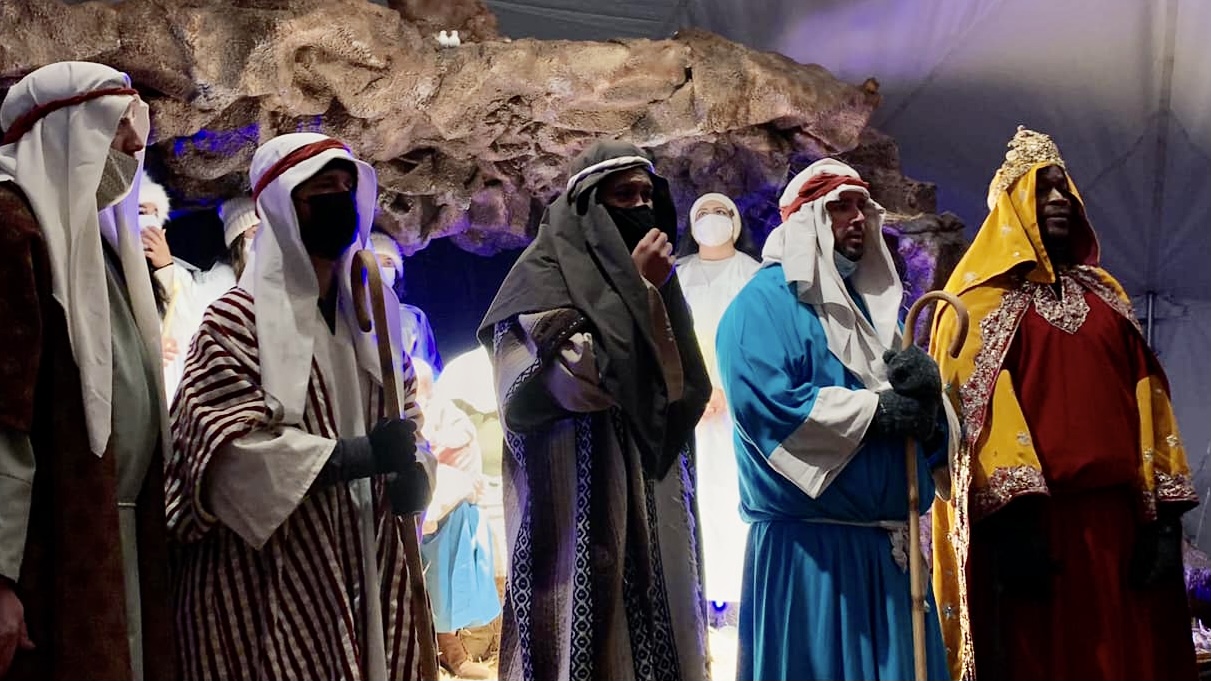
BETHLEHEM EXPERIENCE ATTRACTS 450 VISITORS TO LITTLETON CHURCH

By Alise Weber – Littleton, Colorado … The Littleton Adventist Church grounds was transformed into the City of Bethlehem on December 19 to welcome the community to experience Bethlehem.

Planning for this event began in March and the scale of the event was changed multiple times due to the ongoing pandemic.  What didn’t change was the organizers’ hope to share the Good News and the joy of Christ’s birth with all who attended.  The idea of hosting an event like The Bethlehem Experience became more of a mission as many churches were unable to offer traditional religious Christmas activities for their congregation and communities.

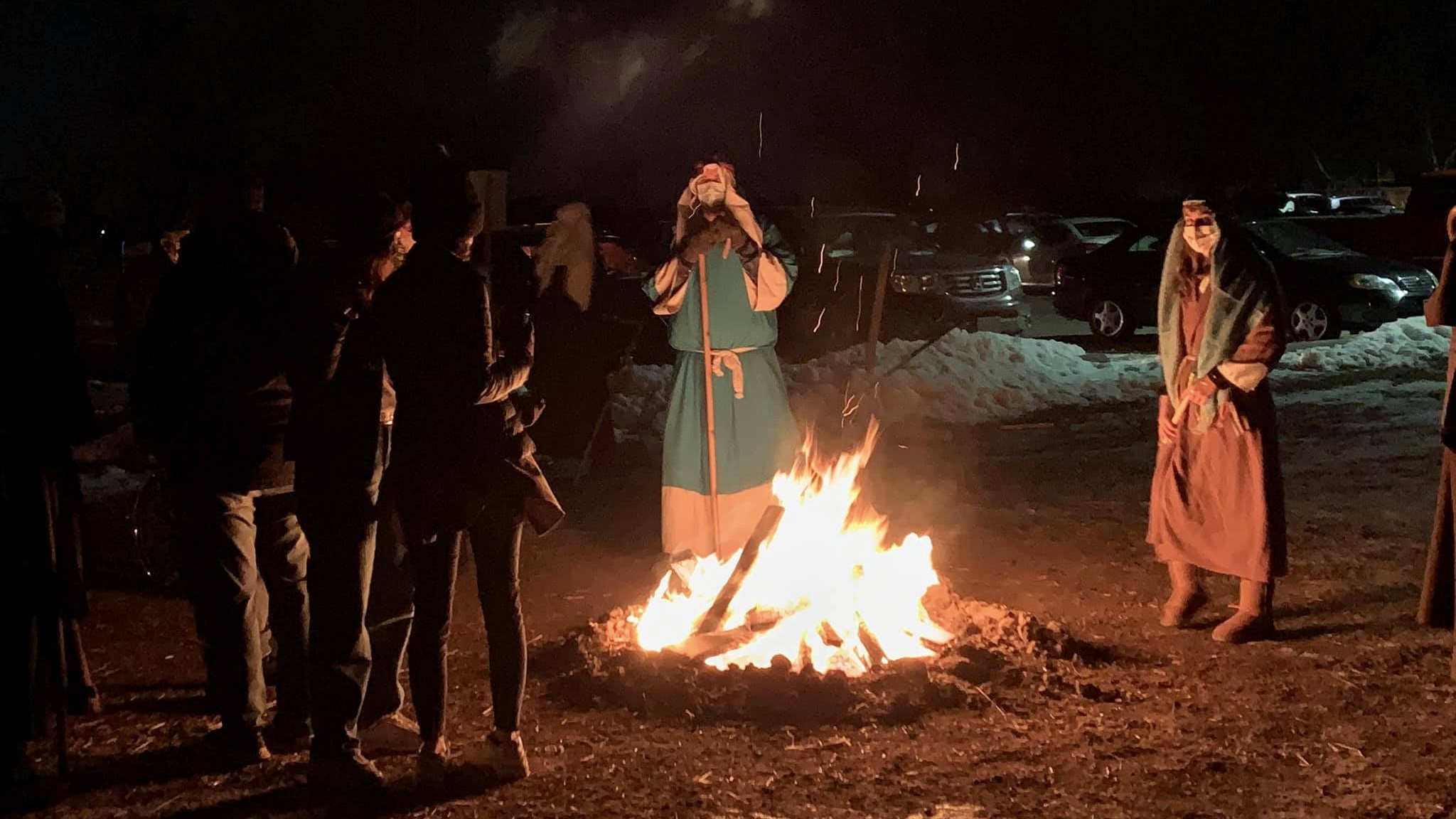
During the event, each group of 40 travelers was greeted by a guide at the Bethlehem gates who shared important information about their visit to Bethlehem.  After the introduction, their guide led them into a busy night market where Roman soldiers loomed in the background.  Travelers were beckoned by marketplace business men and women “selling” fabric, produce, hot drinks, small animals, and cookies. Tax collectors were encountered throughout the marketplace ready to collect “taxes” for Rome.

Exiting the marketplace, the crowd traveled to the shepherd’s fields where the children and young-at-heart could interact with the goats and donkeys there. The fields encompassed an inn with a tired, but cranky innkeeper who was tired of people knocking on the door asking for a room for the evening. The crowd’s attention was drawn to the ancient story of the shepherds watching their flock by night through the narration of Luke 2.  Eyes were drawn to the heavens as fireworks lit up the evening sky, much like the Bethlehem star many years ago.

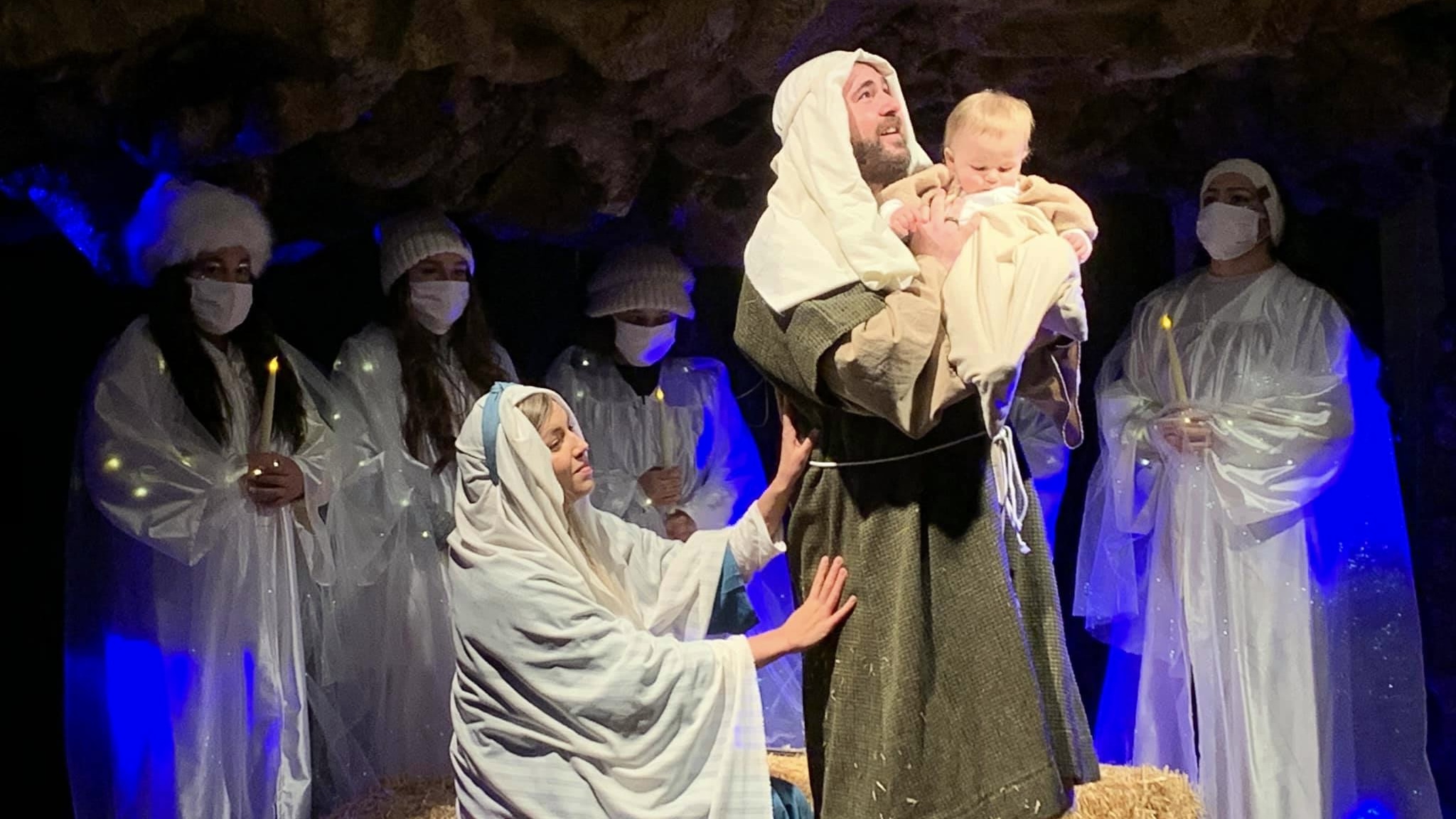
Following the star, the gathering, filled with anticipation, made their way to an ancient cave more than 2000 years old inside the tent. There, those who gathered witnessed Joseph comforting Mary as she prepared to give birth. As angels surrounded the couple, Joseph emerged from the cave holding baby Jesus, played by 10-month-old Sully Palmer. The watching group, moved by the arrival of Jesus, expressed their emotion through applause and tears. Others sat silently, absorbing the scene unfolding before them.

The evening concluded with the Wise Men inviting individuals to rediscover Jesus in the year ahead.

Tierra Hull, invited by a member of the Littleton Church, attended with her husband and two young boys.  After the event, she wrote to her friend, “We LOVED it and hope you do it next year.  My son said it was the most fun tradition ever.  We all feel so blessed to have had a fun Christmas event this season.”

More than 450 people, many visiting Littleton church for the first time, attended the free 30-minute Bethlehem Experience.

With the success of The Bethlehem Experience, Littleton Adventist Church would like to make it an annual event, with the desire of sharing with more and more people the hope, light, and joy Christ’s birth brought to us all.

If you would like to view the Nativity scene, please visit https://www.facebook.com/LittletonSDA/videos/676031106427379

–Alise Weber is Littleton’s Children and Family pastor; pictures courtesy of Littleton Facebook page.

04 Jan

DOING BETTER

By Becky DeOliveira — On my first day of first grade, back in 1978, a girl came to our Seventh-day Adventist K–10 school wearing a pair of gold stud earrings. The teacher asked her to remove them— in accordance with the dress code. The six-year-old girl did not comply, for whatever reason. It is quite possible that her mother had warned her never to remove those studs. Who knows? At any rate, minutes later the new first-grade class was treated to the sight of our teacher, a woman who appeared very old to me with her 1950s-styled grey hair and brown homemade polyester pantsuit, chasing the little girl around the classroom with a broom, swatting her bottom every chance she got. The girl was fast; the chase took the pair outside at one point and I can’t remember now how it all ended. Presumably, the girl was caught and punished.

The next year we were a combined first- and second- grade classroom. There was a boy in first grade who struggled to read and was often sent into an adjoining room with either the teacher’s aide or another student, one who was caught up on his or her work. A wooden paddle went into the room along with them. If the boy made a mistake or failed to cooperate, he was paddled. I remember seeing him often with fat tears rolling down his cheeks.

My elementary school was in the suburbs of a large city on the West Coast of the United States. It was supported by three constituent churches. Two of them were predominantly white churches located in the suburbs. One was predominantly Black and located in the city center. That church had purchased a bus that carried a load of kids across the bridge to the Christian school every day. Would it surprise you much if I told you both the kids, I observed being physically hit in the first and second grades were kids who arrived every day on that very bus? Black kids?

What would you guess as the probability that yours truly would have ever been hit by a teacher—or by a student acting on the teacher’s behalf? Let’s put it at p <.001—pretty low. They would have called my parents.

I’m ashamed to say it, but at the age of six, I didn’t question the disproportionate corporal punishment doled out to the Black kids. I assumed they must be bad kids, must have done something to deserve it. Now I think about their parents, living across the bridge, walking their children to the bus stop every morning and putting them on a forty-five-minute or maybe even hour-long commute to a Christian school where they must have hoped—as all parents do—that their children would be nurtured, treated with kindness, cherished. Loved. It kills me, thinking about it.

I’ve gone on in life to experience many more situations where I am shielded from unpleasantness while others—often Black others—face it. Walking through customs at Heathrow airport, as I used to do on at least an annual basis, it was always interesting to observe the people who had been selected for special screening. At least 90% Black. And dashing through airports with a Black Canadian friend on a journey to London a few years ago reminded me yet again of my privilege. He was stopped at every security checkpoint. Every single one. He, a mild-mannered and unassuming gospel singer. We joked about it, but it wasn’t especially funny. Not really.

That Black church, the one that sent the school bus over the bridge? They stopped sending it just a few years later. There was a disagreement with the school principal regarding the discipline of some of the church’s kids. The white point of view was that the Black church was being unreason- able. Me? I’m not so sure about that. I don’t know their story. No one ever talked about it. That bus stopped crossing the bridge and maybe everyone just forgot about those kids. It would have been an uncomfortable thing to confront, there is no doubt about that. No one likes to think they are behaving unfairly or acting in a way that could properly be called racist. But sometimes people are. And rather than pretending this isn’t happening, to make ourselves feel better, maybe we should acknowledge the inequality and do something about it.

There is a car that blasts through my neighborhood painted in full “Blue Lives Matter” colors. That’s quite a commitment to a statement that seems more about refuting Black Lives Matter than it is about anything else. Yes, we know that blue lives matter. You know how we know? When one of them is extinguished, the punishment is swift, certain, and severe. I knew that my white life mattered back in elementary school. How? Because no one spanked me for a trivial reason. I know it now. Why? Because no one stops and frisks me at the airport. No one pulls me over in my car to ask what I’m doing. No one wonders why I’m jogging through my own neighborhood. As a society, we can do better. We can do better as a church too. We have to.

–Becky De Oliveira is a doctoral student in research methods at the University of Northern Colorado. Email her at: [email protected]

04 Jan

ELLEN WHITE AND SOCIAL JUSTICE

By John Skrzypaszek — The Seventh-day Adventist Church faced challenging issues during the 20th century concerning life in a progressively-changing world. Rapid developments in industrialization, urbanization, immigration, and the exponential growth of cities heightened the presence of injustice caused by “indifference to human suffering” (Testimonies to the Church, 9, p. 89). Furthermore, internal denominational disputes, engendered by theological and organizational conflicts, di- verted the Church’s attention from the primary purpose of its mission in the world. Morgan argues that in the context of general societal issues, “Ellen White guided Adventists’ responses to the nation’s social problems” (Ellen Harmon White: The American Prophet, p. 224). Consequently, her counsels drew attention to social justice as an intrinsic part of the movement’s missional activity.

This brief reflection refrains from discussing White’s understanding and response to all aspects of social justice through the selective use of quotations, but rather aims to recapture the inspirationally-nurturing and visionary depth of her inspired voice from the trenches of her lived experience.

In a letter penned to Elder O.A. Olsen in January 1905, White described her visit to Battle Creek, Michigan. First, the recollections are fascinating because they delineate her role as God’s Messenger. Second, she was asked whether the views she held years ago changed. In response, she affirmed her beliefs’ unchanged continuity, but placed them in the context of the “same service” that the Master placed on her in the early years. One wonders what she meant by the continuity of her “unchanged views” and “same service.”

White’s progressive understanding of the biblical truth matured. She encouraged the Church to immerse life experience in the power of God’s Word to “discern more clearly the compassion and love of God” revealed in “Christ and Him crucified” (Circulation of the Great Controversy), a place where one finds “mercy, tenderness, and forgiveness, blended with equity and justice” (Acts of the Apostles, p. 333) She argued that “we should not only know the truth, but we should practice the truth as it is in Jesus.” This focus remained an unaltered mandate of her entire ministry—truth in terms of its practical application in the “Lord’s service” (Letter to Olsen).

In this context, she recalled her calling’s specific nature: “I was charged not to neglect or pass by those who were being wronged. . . . . I am to reprove the oppressor and plead for justice. I am to present the necessity of maintaining jus- tice and equity in all our institutions”(Letter to Olsen)

Space does not permit a detailed analysis of White’s response to the wide range of social justice issues, both with the community of faith and in society at large, but her influence’s impact commenced at the ground level of practical responses to human needs. Soon after her marriage in 1846, God instructed her to show a particular interest in motherless and fatherless children. She understood this responsibility as part of God’s missional response to human suffering (Isaiah 58: 6-7) with a specific goal: “I have taken children from 3 to 5 years of age and have educated them and trained them for responsible positions” (Letter to Olsen).

During White’s tenure in Australia, her home, Sunnyside, in Cooranbong, became “an asylum for the poor and afflicted” (Review and Herald, 1906). Her concern for the sick and suffering “won [the] confidence of the people” (Letter to Olsen). Thomas Russell, a local businessman, summarized the impact of her influence: “Mrs. White’s presence in our village will be greatly missed. The widow and the or- phan found in her a helper. She sheltered, clothed, and fed those in need, and where gloom was cast, her presence brought sunshine.” In her life and practice, the truth in Jesus translated into practical Christian experience, a place where people felt kindness and loving care.

The Great Controversy theme (1858-1888) contributed to White’s in-depth understanding of God’s love and His purpose for life in a broken world. It highlighted the value of freedom of choice and the intrinsic value and potential in human life. The named theme extended her ministry’s im- pact beyond the boundaries of the Adventist community into the “public arena—race relations and religious liberty” (Ellen Harmon White: The American Prophet, p. 236).

During her time in Australia, she wrote extensively on is- sues relating to colored races. In 1891, she wrote, “The Lord Jesus came to our world to save men and women of all nationalities. He died just as much for the colored people as for the white race. Jesus came to shed light over the whole world” (“Our Duty to Colored People”). In 1896, she cautioned the Church: “The walls of sectarianism and caste and race will fall down when the true missionary spirit enters the hearts of men. Prejudice is melted away by the love of God” (Review & Herald). Her appeals aimed to resonate beyond the realm of political activism. More precisely, she aimed to challenge the Church with a “new initiative to reach the nation’s impoverished and oppressed black population” (Ellen Harmon White: The American Prophet, p. 236). Consequently, her messages were inspirationally motivational and missional.

The example of her unique response to the ills of social injustice emerged from her sensitive approach to the abuses and mistreatment of indigenous people in Australia. While writing extensively about equality, she never made a direct reference to the country’s racial prejudice. Nonetheless, her voice motivated the Seventh-day Adventist Church to speak out against this social evil.

After her departure to America, The Bible Echo (August 19, 1901) published an editorial expressing the Church’s protest against government abuses and mistreatment of the indigenous people: “Every opportunity should be improved to create a public sentiment against the brutal customs above described until the authorities take hold of the matter and inaugurate a vigorous reform. The blot is a foul upon the country and should be eradicated without delay.”

Indeed, her counsel challenged Seventh-day Adventists to speak out against oppression and injustice, not merely as a forum for political activism, but as an intrinsic part of the movement’s missional activity to uplift and restore human value and dignity streaming from God’s kingdom of grace.

–John Skrzypaszek, DMin, has recently retired as the director of the Ellen White/Seventh-day Adventist Research Centre, and is a lecturer at Avondale University College (2005-2020), Cooranbong, NSW, Australia. Polish by birth, John takes a keen interest in heritage, spirituality and identity studies. He is married to Brenda and has two sons, Raphael and Luke. Email him at: [email protected]

04 Jan

CONFESSIONS OF A SOCIAL JUSTICE WARRIOR

By Dany Hernandez – “SHHHHHH . . . Don’t Say Those Words.”

The Compliment

Fun Fact: My full name is Dany Hernandez Lizardo Garrido Gomez Consepcion Guzman Velazquez Garcia.

I’ve been called many things—Dan, Daniel, Horrendous, Lizard, Pastor, Vicar, Paco. I’ve been described as loud, passionate, authentic, fake, caring, mean and, in one instance, a “snake in the grass, back-stabbing, two-faced liar.” I’ll be honest. That last one is still a bit confusing to me as well as others who were present. Immediately, I had multiple individuals tell me, “Don’t take it personally. They just don’t know you.” Sure, I’ll chalk it up as ignorance on the part of the person who said those things about me, but it still stings. It still hurts. It still feels wrong.

But then, there was this one time when I was super excited because I heard some people describing me as a Social Justice Warrior. Social Justice Warrior. That sounds impressive doesn’t it? At least, I thought it did. After all, the final words of the Pledge of Allegiance are, “liberty and justice for all.” Maybe it’s just me, but I have a sense that many of us have placed our hands over our hearts at some point and have taken an oath committing ourselves to doing our part to establish a society where all are free, where all are treated with equal justice, and all are given an equal opportunity to live in peace and happiness.

So, needless to say, being called a Social Justice Warrior brought out in me a sense of pride and honor. I was living out what we, not just as Christians, but also as Americans stand for. I was living out what I thought our Founding Fathers and our church stand for.

The Insult

That is, until I realized that those three words are a bad thing. A friend pointed out to me that “Social Justice Warrior” was a derogatory term. To my surprise, after a bit of research, I found the hashtag #SWJ all over the Internet and was devastated to learn I was not being complimented, but instead, insulted—the equivalent of “a snake in the grass.”

I’m still trying to figure out how the words “social justice” became such a repulsive phrase to so many Christians, when in fact, it is the single most common theme in the Bible. This dynamic creates a difficult tension to manage. I can almost guarantee that every one of our pastors and church leaders would say that “social justice” is not only important, but it is a critical and foundational part of Christianity. However, because certain political parties and organizations that we might not align with have become vocal about “social justice,” we shy away from doing the right thing in order to protect ourselves. Let’s be honest. At times, it’s called “self- preservation”. I get it.

The Party

Mark 2:15-17: “And as he reclined at table in his house, many tax collectors and sinners were reclining with Jesus and His disciples, for there were many who followed Him. And the scribes of the Pharisees, when they saw that He was eating with sinners and tax collectors, said to His disciples, ‘Why does he eat with tax collectors and sinners?’ And when Jesus heard it, He said to them, ‘Those who are well have no need of a physician, but those who are sick. I came not to call the righteous, but sinners.’”

OK, we don’t know if it was a party or not. This is what we know. Jesus invites Levi, “Follow me,” and he does. As a tax collector, Levi did not hang out with church people, so we could probably assume Levi’s friends were outcasts of the religious and faith community of the time. The other thing we know is that at some point between Jesus’ invitation to follow Him, there was another invitation from Levi to come and hang out with “the sinners.”

Jesus could have declined the invitation to gather with questionable and marginalized characters for reasons of self- preservation. See what I did there? Jesus could have made certain demands of Levi regarding the food, the beverage, the music, and the guests before he accepted the invitation in order to avoid tension among the faithful. Jesus could have simply said, “No thank you.”

Not only do we see Jesus accepting the invitation as it was, but now we find him, “reclining” with sinners.

The Questions

Two things jump out at me:

  1. Reclining = In no rush
  2. Reclining = A posture of approachability

So, I pose a few of simple questions based on this observation. Is your church in no rush? Are you willing to work with a group of people for years and be present as the community grows and transitions? Are you able to take your time developing meaningful relationships by stepping out of your comfort zone and stepping into someone else’s territory as uncomfortable as that might be? Do you lead with a posture of authority or a posture of approachability? It’s interesting that the Pharisees never sat down to teach the Torah. They always stood in a posture and sign of authority. But somehow, Jesus takes a different approach. He knew these people would never attend church. He knew they would not even be allowed in church. Instead, Jesus reclines. He knew that it was more important for him to be present and approachable than it was for him to be right and authoritative.

How present and approachable are you? How present and approachable is your church? I’m not talking about people who believe, act, dress, eat and talk like you. How present and approachable are you with the kind of people Jesus reclined with?

Here’s the deal: “Social justice” or should we say, “helping the vulnerable among us” so as to not offend anyone, can only be maintained and implemented in the context of presence and approachability.

The Problem

If you are going to be fully committed to “helping the vulnerable among us,” then some people will feel left out. Take for instance Black Lives Matter (BLM). Some of you probably just stopped reading. That’s OK. But if you continue reading, hear me out.

Let me be vulnerable with you. For those of you who don’t know, we have triplets who will be turning 18 in January 2021. One of my kids has recently been challenged with more things than a teenager should be challenged with. This has required a tremendous amount of time, finances and resources on the part of our family. Many times, my wife and I have lost sleep, cried and felt guilty because of the lack of quality time we’ve been able to dedicate our other two. Does that mean we love them less? Of course not. But because of what we are going through at this point in time, it is necessary we call out the need to dedicate extra time and attention to that one child. If my teenage kids can understand this, why can’t some of us?

“But . . . but . . . do you know that BLM . . .” I do. And I’ve come to realize I don’t have to agree with everything someone stands for in order to support certain causes. I’m sure you don’t like how things ended with Dr. Kellogg, but you still eat cereal, don’t you? If we find ways to celebrate what is good instead of focusing on what is wrong, we’ll begin to find beauty and light in otherwise dark and gloomy places.

The Advice

Lin-Manuel Miranda, writer and composer of the Broadway musical Hamilton, wrote a line for the character of Aaron Burr played by Leslie Odom Jr., that should become foundational to all of us.

In the second song of the musical, Alexander Hamilton meets Aaron Burr and proceeds to go on a rant about university, family, country. Hamilton, wanting Aaron Burr to know everything he stood for within a few minutes of meeting him, ends up completely overwhelming Aaron with information. Out of nowhere, Aaron Burr interrupts Hamilton and tells him, “Let me offer you some advice. Talk less, smile more . . .”

What would it look like if we, as Jesus’ followers, took that advice? What if our churches were known for our smiles instead of our talks? What if we were more concerned about approachability than authority?

I think if we did, we would be doing the very thing that God requires of us according to Prophet Micah.

But he’s already made it plain how to live, what to do, what God is looking for in men and women.

It’s quite simple: Do what is fair and just to your neighbor, be compassionate and loyal in your love, and don’t take yourself too seriously—take God seriously (Micah 6:8).

Mercy, justice and humility—the foundations of our Chris- tian faith and the basis of “social justice.” There, I said it.

–Dany Hernandez is Lead Chaplain at Littleton Adventist Hospital, Little- ton, Colorado. Email him at: [email protected]

04 Jan

WHEN THE WEALTHY GO BEGGING

By Doug Inglish — Typically, when we see people looking for handouts, we presume they are poor. We could have an all-day-long sociological discussion on the causes, whose fault it is, or whether giving to them is appropriate, but none of that would change the underlying assumption that such people are poor. You may have heard an urban legend or two about exceptions, which even if true, would never account for the overwhelming majority who gather at intersections or in front of stores with cardboard signs.

And of course, we read news stories about “corporate welfare,” which would be at the other end of the scale—big companies with millions of dollars in assets who are seeking tax breaks, grants, or donations. In this case, we could have an economic discussion on the nature of capitalism, or a political discussion on whether the government should pick winners and losers, or a host of other issues related to whether the public, through one form or another, should support big companies who pay their top employees many times the median salary of a taxpayer.

In both situations, there are pros and cons to giving support. Fair minded, compassionate, intelligent people can disagree about handouts to street people or write-offs for corporations. But there is probably one thing we would all agree on: If a rich man, who had immediate and unfettered access to all his assets, asked you for a handout, that would be appalling.

I suppose those who just like to argue could conjure up circumstances where it would be appropriate (the diner won’t take his credit card) but notice that I said immediate and unfettered access to all assets. So, sweeping aside any bizarre scenarios, I’m talking about an embarrassingly wealthy person who could easily pay for anything outright, asking you to give him money with no goods or services rendered in exchange. I don’t think any of us would excuse that for a moment.

Why, then, does God ask you for money?

No question that He has the resources: “For every animal of the forest is mine, and the cattle on a thousand hills” (Psalm 50:10) “The earth is the LORD’s, and everything in it, the world, and all who live in it” (Psalm 24:1).

Of course, He also has immediate access to His vast wealth. As the angel said to Mary, “ . . . with God nothing shall be impossible” (Luke 1:37). That pretty much covers access, along with a whole lot else.

Does He need your money? There is an interesting pas- sage about that in Psalm 50:12: “If I were hungry, I would not tell you, for all the world is mine and everything in it.”

That’s sort of like telling me, “If we need someone for special music, we aren’t going to call on you.” I would never be insulted over that because I have nothing to offer in terms of musical performance. It’s just not in me, and there is no shame in me coming to terms with it and admitting the obvious truth that I don’t have that talent.

Neither is there any shame in any of us admitting that if God was hungry, there is nothing that any of us could do about it. Does God get hungry? Well, that’s a whole other subject, but if He did, why should He tell us? He can do everything, and we can do nothing, so no point in complaining to the wrong people.

In the context of this passage, hunger is a stand-in for needs in general. It’s similar to the familiar line in the Lord’s Prayer, “Give us this day our daily bread. (Matthew 6:11). That’s the only part of the prayer that addresses our personal needs, so if we want healing, or housing, or work, or help with a geometry test, it all falls into the general category of “daily bread.” Asking for daily bread is shorthand for requesting help with our personal needs.

Therefore, when God says, “If I were hungry, I would not tell you,” the broader meaning is there is no point in Him asking us for any personal need, because we could never supply it. Heaven is His home, creating and managing the universe, is His job, and everything in the physical world is His possession, so what could you do to meet any of His needs?

Nothing. At all. Ever.

So then, why does He ask for your money? Obviously, it is not to meet the needs of the One who owns it all and wouldn’t tell you if He was hungry. So, if it’s not because He needs your money, then the reason He asks must lie at the other end of the giver-receiver transaction.

He asks for your money because of your needs, not His.

It’s not merely because His cause needs support, or that you will be blessed in return (see Malachi 3:10 on both of those points), although both are true. Rather, it involves the more essential elements of your relationship with Him:

Giving builds trust
Giving recognizes His ownership
Giving declares that you are His
Giving says that you support His cause
Giving teaches you to care about the things He cares about
Giving helps you understand the Giver

Those are all relational matters. They have little to do with needs, which makes sense in a relationship where the only need we can possibly fill for God is the need He has to connect with us.

I used to live in a house with nearly an acre of lawn, and I absolutely loved mowing it. As long as I was on that lawn tractor, I had time to think about anything. I could credibly say that I was accomplishing a necessary task, while at the same time, I was not answering the phone, preparing for a meeting, or addressing an unpleasant matter with an angry person. I was mowing, and I used that time to think about whatever I wanted, not what someone else demanded. It was blissful. The last thing I needed was someone to take that from me.

But at the same time, I had a son who was just about the right age to take on some responsibilities for lawn care. So even though I did not need him in the least to help me mow, I taught him how to do it. I showed him how to maintain the trimmer, the push mower, and the tractor. I let him do each task under my supervision, then on his own. The truth is he didn’t enjoy it at all, and I missed just doing it myself, but I had something more important in mind than the length of the grass. I was teaching him to be a responsible adult, and building a relationship with him by having him work with his dad.

Then came the day that he had his own lawn. He called me up to talk about what he should look for in a mower. He respected my experience and welcomed my opinion because we have a relationship, and it matters to both of us.

God does not need your money any more than I needed Josh to help me with the lawn. But He wants to see you grow to spiritual maturity just as I saw the need for my son to develop the skills he would need in adult life. And God wants a relationship with you, just like I wanted time with my son. He loves His work of creating and maintaining the universe, and He doesn’t need your help to manage any of it. But part of running that universe is having you be a meaningful part of it.

So how does He, who owns everything and wouldn’t tell you if He was hungry, help you, who have nothing and couldn’t do anything for Him, develop into spiritual maturity? How does He grow a relationship with you in which you learn to depend on Him, understand His role in your life and your place in His work, and see the world as He sees it?

In part, He asks for your money. It’s not about His needs. It’s about yours.

Doug Inglish is RMC director of planned giving and trust services. Email him at: [email protected]

1 162 163 164 165 166 255